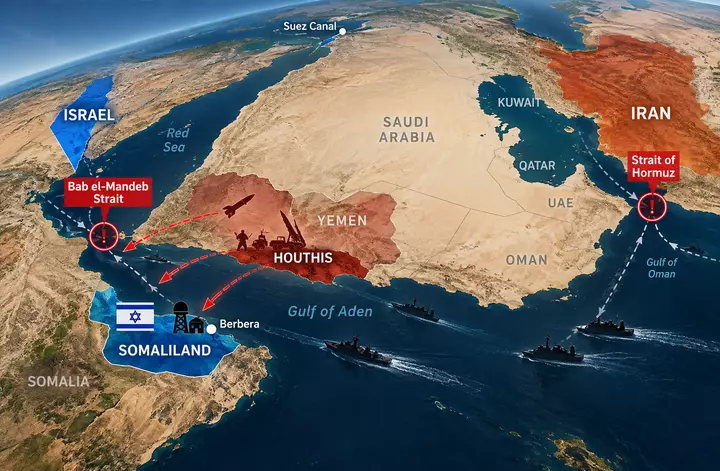
The Middle Eastern War is now expanding from its traditional battlefield into a broader theater of conflict, with Yemen and the seas around the Arabian Peninsula becoming one of the major fronts of such escalation. The initial conflict, which was aimed at Israel and merchant vessels by the Houthi movement that is aligned with Iran, has been transformed into a bigger dispute between Saudi Arabia, the U.S., and possibly even Africa's shores of the Gulf of Aden. The Gulf seems to be caught between Hormuz and Bab al-Mandeb The latest escalation has exposed the vulnerability of even the region's most heavily defended infrastructure.
On October 10, a Houthi attack on King Khalid International Airport in Riyadh killed at least 13 people and injured more than 300, according to subsequent reports. A further strike the following day killed a Pakistani national and wounded 11 others. Saudi authorities have since investigated the failure of their air defences, while international airlines have suspended services and the airport is expected to remain closed until at least October 17.
Interestingly enough, the attacks have also reopened a sensitive diplomatic question, whether Israel and Saudi Arabia could find common military ground against the Houthis despite the absence of formal relations. Because, according to an October 12 report by Haaretz, Israeli Prime Minister Benjamin Netanyahu has sought Saudi approval, through American intermediaries, for Israeli participation in operations against the Yemeni movement. Crown Prince Mohammed bin Salman has reportedly resisted the proposal, fearing a domestic backlash against overt military cooperation with Israel.
The claims remain unconfirmed by Saudi authorities, but they illustrate the complicated intersection of security interests and political constraints confronting Riyadh. Yet the potential geography of this confrontation extends much further than Saudi Arabia. Across the Gulf of Aden, on the African shore facing Yemen, Somaliland has emerged as a possible strategic foothold for Israel.
In December 2025, Israel became the first country to formally recognise Somaliland's independence, a decision condemned by Somalia and criticised by several regional governments. Three months later, Bloomberg reported that Israel was exploring a possible military and intelligence presence near Berbera, raising questions about whether the Gulf of Aden could become a new theatre of operations against the Houthis. For Lebanon-based political analyst Hazem Al-Tawil, the significance of these developments lies in the unusual possibility of an Israel-Iran confrontation extending to opposite shores of a strategically vital maritime passage.
In his commentary to AzerNEWS, he drew attention to the emerging geographical relationship between Somaliland and Houthi-controlled territory in Yemen, arguing that the Gulf of Aden could develop into a flashpoint of its own rather than remaining merely an extension of the Red Sea shipping crisis: "When we examine the map of the Gulf of Aden, an interesting geopolitical configuration emerges. On its southern shore lies Somaliland, which Israel recognised in December 2025. On the opposite shore, roughly 260 kilometres away in the area under consideration, are the Houthis, who belong to the Iran-aligned Axis of Resistance and have been attacking Israel and shipping in the Red Sea since 2023.
Extract — continue reading at the source.