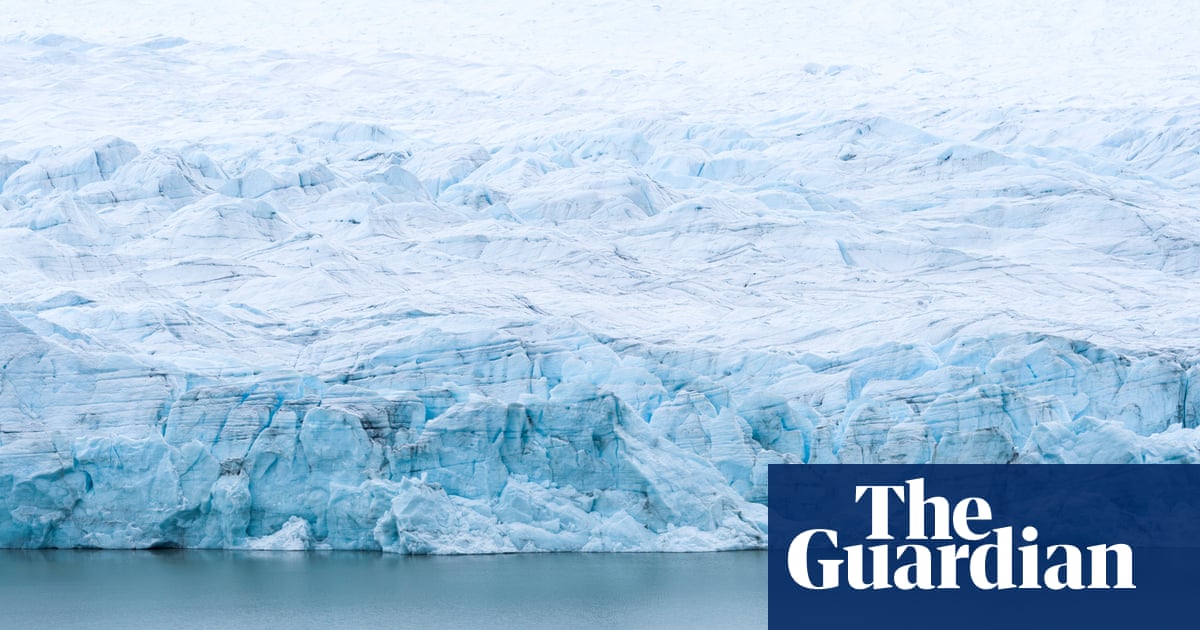
Earth’s icy regions face such dangerous melting that global heating should be brought back below 1C after an inevitable period of overshooting global temperature targets, a UN report has found. Permanent and widespread losses of snow and ice expose a “persistent myth” that overshooting the 1.5C target of the Paris climate agreement – to 2C or 3C – could be manageable or even preferable to urgent cuts to emissions, the report found. The planet has heated by 1.3C since pre-industrial times and failures to curb greenhouse gas emissions and protect nature have led scientists to conclude that some level of overshoot is inevitable as they fight to keep end-of-century warming to 1.5C.
But extreme effects on the cryosphere – Earth’s water in a solid state, including all its ice and snow – mean temperatures must rise above that threshold for as short a period as possible, the scientists urged. Added to this, enough planet-heating carbon should be removed from the atmosphere to bring long-term warming down much further, ideally below 1C by 2150. The high overshoot expected under current policies – with peak temperatures of about 3C – would thaw nearly all near-surface permafrost, make “severe and possibly abrupt” disruption to ocean circulation likely, and lead to widespread acidification, the report found.
The latest scientific research suggests sea ice recovers more slowly than previously thought. The report, written by 80 scientists brought together by the International Cryosphere Climate Initiative (ICCI) and the UN Environment Programme (UNEP), found much of the damage would be permanent even if global temperatures were brought back down to 1.5C, such as glacier melt raising sea levels and threatening water security. James Kirkham, a glaciologist at ICCI and the lead author of the report, said the cryosphere is “one of the most sensitive components of the climate system”, and the consequences of its loss affect the whole planet.
Glaciers, which are still responding to historical warming, would only preserve about 70% of their current volume over a timescale of centuries if long-term heating were brought back down to 0.8C, the report found. Meanwhile, the ice sheets covering Greenland and Antarctica, which are melting about six times faster today than in the 1990s, would continue to lose ice even in scenarios where overshoot is brief and temperature rise returns to 1.5C, the report found. The scientists said a safe, long-term temperature limit for polar ice sheets lies much closer to 1.0C of global heating, and possibly even lower.
It found there were “no good outcomes” of remaining above 1.5C. The cryosphere report found that current policies, which will result in 2.8C of global heating, would reduce the mass of glacier ice to below 10% in the Rockies, Alps, Iceland and Scandinavia. If warming was limited to 1.5C, about 20-35% of the mass would remain.
In the Hindu Kush Himalayas, where glaciers are a source of water for nearly a quarter of humanity, current policies will leave just 41% of the ice mass. If warming was limited to 1.5C, 83% would remain. Bill Hare, a climate scientist and the CEO of Climate Analytics, a policy institute, who was not involved in the report, said: “Ice sheets melting six times faster than 30 years ago, sea ice and mountain glaciers disappearing at record speed, sea levels inexorably rising, the life-giving polar oceans acidifying: all irreversible now on human timescales, all laden with worldwide consequences, and all taking climate impacts past limits of adaptability.” He added: “Every government minister and every fossil fuel executive who’s ever succeeded in watering down climate action can look at this report and see how their actions have fundamentally damaged the world we live in.”
Extract — continue reading at the source.