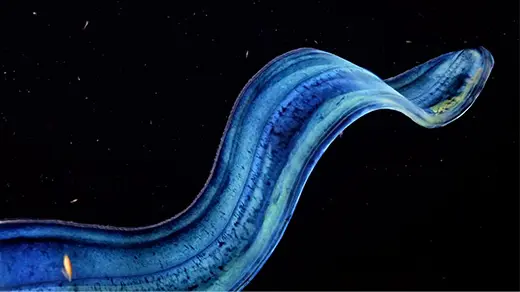
Around 700 million years ago, a group of organisms resembling little more than glowing, gelatinous blobs split off from the rest of the animals, forming possibly the earliest branching animal lineage. Nearly 200 species of ctenophores, commonly known as comb jellies (but unrelated to jellyfish), live today in environments ranging from the cold depths of the sea to warm coastal surface waters. Their magic isn’t just in their persistence or iridescence; it’s in their DNA.
Over the past decade, ctenophores have helped answer long-standing questions about fundamental biology, from how early nervous systems evolved to the origins of the mesmerizing phenomenon of bioluminescence. Having access to closely related species across such variable environments “lets you ask questions about how certain things evolved,” such as adaptation to high pressure or light-sensing genes, said Steven Haddock, a marine biologist who studies ctenophores at the Monterey Bay Aquarium Research Institute. But over the past two decades, evidence has emerged that ctenophores were earlier.
In 2023 — after years of a “ping-pong game” between labs debating which group came first, Burkhardt said — a landmark paper analyzing chromosome organization found that ctenophores, not sponges, are the sister group, though this is yet to be fully settled.
Extract — continue reading at the source.


/https://tf-cmsv2-smithsonianmag-media.s3.amazonaws.com/filer_public/d6/3a/d63ab0e1-1057-4fce-8f8c-c0ea8bb2ea6e/a_1-fused-groups-of-anglo-saxon-coins-found-in-recent-excavati-95fcea8df7df53c8c8b6485cc9f1e443.jpg)