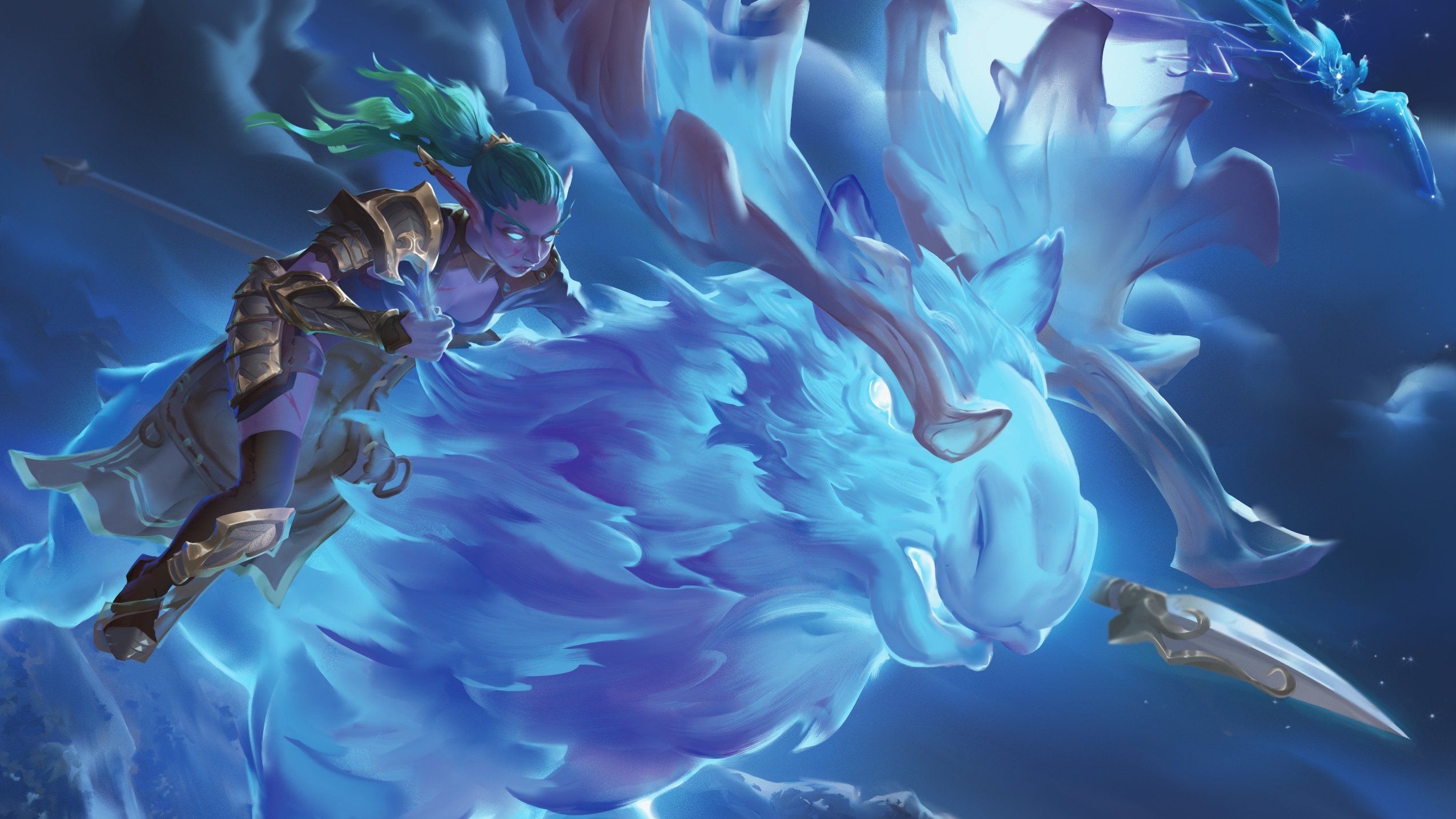
Mounts in World of Warcraft are status symbols, a way of showing off the challenging raids you’ve completed or how far in the PvP ranks you’ve climbed. Dungeons & Dragons: World of Warcraft lead designer James Wyatt couldn’t help showing off himself a bit in the book’s art, where he slipped in an image of his Night Elf warrior riding the Spirit of Eche'ro. Acquiring the spectral moose required spending hours digging up bone fragments with the Archaeology profession, an activity so tedious it was discontinued after the 2018 expansion Battle for Azeroth.
Fortunately, getting those rare cosmetic items is much easier in the Dungeons & Dragons expansion than in WoW. A character proficient in history can spend an hour or a short rest searching the site of Highmountain Tauren ruins for Archaeology fragments. If they gather six, they can be assembled into a staff that casts the Find Steed spell, summoning the famed moose once ridden by the Tauren hero Huln Highmountain.
Wyatt also lets players acquire the Cenarion War Hippogryph, another mount he spent a lot of effort on, by raising their Renown with the Cenarion Circle through protecting the natural balance of Azeroth. It's a game about stuff you do as a group together,” Wyatt told Polygon in a virtual interview. Others are meant to establish the close ties between WoW and D&D.
A gnome is used as the signature Warlock in both D&D: WoW and the Player’s Handbook, and the WoW book’s gnome art depicts them constructing a mechanostrider mount just like the Player’s Handbook version has them building a golem. Wyatt and lead art director Sergio Jaramillo spent a lot of time playing WoW so they could provide artists with guidelines to ensure the book’s illustrations were true to the game. We have to go through it, compare it, triple-check, and then maybe it’s ready.
We sent it to Blizzard, and maybe Blizzard catches something we didn’t. A couple of times there were like, ‘We didn’t know this was there. Nice catch.’” The team wanted to be precise with its modeling of characters, and even carefully counted the fingers and toes for Azeroth’s various species.
They wanted to be sure to replicate unusual features, like trolls’ hunched posture, and the full range of eye and hair colors. They would build characters in the Wowhead Dressing Room, a digital tool that lets you recreate any character build and deck it out in equipment, and then commission artists based on the renders. There were times Blizzard couldn’t help them because the models simply didn’t exist in the game.
Extract — continue reading at the source.