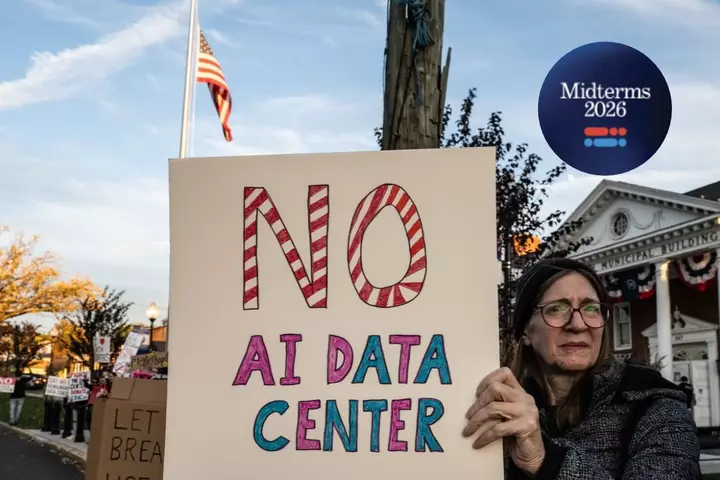
Republicans were not the only big losers of the 2026 midterms—the AI industry lost as well. After data centers became the focus of numerous campaigns, lawmakers with records most in favor of accelerating AI adoption were most likely to be among the defeated incumbents. Newsweek’s AI Policy Scorecard rated every sitting member of Congress based on their voting records and public statements on AI policy on a scale of 1, AI Skeptic, to 5, AI Booster.
At the time of publication, the incumbents who lost had mostly booster scores: two of the five incumbent Republican senators who were defeated, or 40 percent, had AI booster scores, while a third, Darline Graham of South Carolina, was the biggest recipient of AI booster campaign donations of the cycle. In the House, 87 percent of the House Republicans who lost, or 13 of 15, were also AI boosters. The boosters who lost Senate races included Ashley Hinson of Iowa and Jon Husted of Ohio.
The boosters who lost in the House include Gabe Evans of Colorado; Mariannette Miller-Meeks and Zach Nunn of Iowa; Ann Wagner of Missouri; Thomas Kean Jr. of New Jersey; Mike Carey of Ohio; Rob Bresnahan, Brian Fitzpatrick, Ryan Mackenzie, and Scott Perry of Pennsylvania; Jen Kiggans of Virginia; Bryan Steil and Derrick Van Orden of Wisconsin. While the AI Policy Scorecards found that the average views of Republican and Democratic lawmakers were close on four of the five categories they were scored on—safety, jobs and economy, regulation, and national security—the one area where party predicted a member’s stance was support of data centers. Republicans in Congress average a 3.64 Lean Booster score on Data Centers while Democrats are Lean Skeptics at 1.97.
Opposition to constructing data center projects was one of the most discussed topics of the campaign, along with approval of President Trump, affordability, and corruption. Seven in 10 Americans oppose the construction of an AI data center in their own community, a May Gallup survey found, and as the issue grew in salience, so did its presence on the campaign trail. South Carolina, one of the most shocking Senate flips of the night, saw Republican Senator Graham lose to Dr.
Annie Andrews, who ran ads slamming the incumbent as "Data Center Darline." Those ads framed Graham as a puppet of the president more concerned with promoting his data center than reducing living expenses for constituents. It didn’t help that Graham was one of the largest recipients of AI money this cycle, taking in $4.5 million. "This election was about costs and corruption," Larry Huynh, a Democratic consultant who works on AI issues, told Newsweek.
"Data center builders got tax breaks, money in their pocket, to build these things while at the same time voters were paying higher electric bills, having issues accessing water, and seeing their utility costs go up. That left folks feeling like these guys worked the system to not only cause their cost of living to go up but to also get money to make more money in the future." As the Democratic Party continued to hit the Trump Administration over rising prices and mounting concerns that his policies were enriching his friends and family, the president made vocal his support for data centers. "The only reason that communities throughout the U.S.A. should not want Data Centers is if they want to end up being backwards and poor," he posted to Truth Social in August.
Extract — continue reading at the source.





