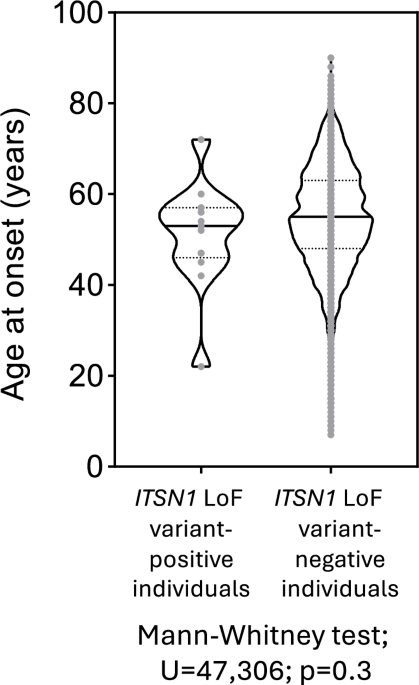
We read with interest the recent studies by Skuladottir and colleagues and Cogan and colleagues, which report a novel association between monoallelic loss-of-function (LoF) variants in the ITSN1 gene and risk for Parkinson’s disease (PD)1,2. The first study observed that heterozygous LoF variants in ITSN1 confer a large risk for developing PD in analyses combining the deCODE, UK Biobank, and Accelerating Medicines Partnership Parkinson’s Disease (AMP-PD) datasets1. The second study identified five PD patients from three families who harbored distinct heterozygous frameshift ITSN1 variants and reported their clinical phenotype2.
Yet another recent study reported similar results in an analysis of the UK Biobank, the AMP-PD, and the All of US cohorts, where they observed an increased risk of PD in individuals with LoF variants in ITSN1 and provided functional evidence in a Drosophila model, showing an interaction between ITSN1– encoded Intersectin-1 and α-synuclein3. Still, the clinical manifestation of PD in patients with LoF variants in ITSN1 remains largely unexplored. We aimed to investigate the reported association of ITSN1 LoF variants with PD in a large independent patient group and to determine whether patients with ITSN1 LoF variants present with a clinically distinct PD form.
We investigated our data from the Rostock International Parkinson’s Disease (ROPAD) study (NCT03866603), an observational clinical study that enrolled and genetically characterized PD patients from Europe, the Americas, and Israel4,5. Our analysis included data from 8660 reportedly unrelated PD patients recruited in Europe (68%), North America (16%), Israel (10%), Turkey (4%), and South America (2%) between April 2019 and August 2024 who had exome sequencing (ES) or genome sequencing (GS) data available and no relevant variants in known PD genes. Specifically, the patients analyzed in the present study did not have (i) a pathogenic (P) or likely pathogenic variant (LP) in an autosomal dominant PD-related gene (LRRK2, SNCA, VPS35, RAB32, and CHCHD2), (ii) two heterozygous or one homozygous P/LP variant in an autosomal recessive PD-related gene (PARK7, PINK1, and PRKN), or (iii) a P, LP, or risk factor variant in GBA1.
In addition, we examined the presence of ITSN1 LoF variants in 210,657 ES- or GS-tested individuals of diverse ancestries from the CENTOGENE Biodatabank who were referred in various types of settings (routine exome/genome-based diagnostic genetic testing, healthy parents from trio analyses, or participants of other observational clinical studies) and who were not referred for or diagnosed with PD. ITSN1 LoF variants were defined as start-loss, stop-gain, stop-loss, splice-donor, splice-acceptor, or frameshift variants, predicted by CENTOGENE’s in-house bioinformatic pipeline6,7. We extracted ROPAD study electronic case report form (eCRF) information from the Centogene Biodatabank, including year of birth, sex, age at disease onset (AAO), age at PD diagnosis (AAD), age at enrollment (AAE), family history of PD, and motor clinical evaluation (partial UPDRS part III), and compared all available parameters between ITSN1 LoF variant-positive and ITSN1 LoF variant-negative study participants4,8,9.
The disease duration (DD) was calculated as the difference between the AAO and the AAE. Statistical analyses (linear regression, Mann–Whitney, Fisher’s exact, and Pearson chi-square tests) were performed with GraphPad Software (version 11). We identified 13 PD patients with heterozygous ITSN1 LoF variants.
This corresponds to 0.15% of the ROPAD patient group and represents a significant enrichment over the 0.025% in a group of 210,657 ES- or GS-tested individuals from the CENTOGENE Biodatabank (odds ratio (OR) = 6.09, 95% confidence interval (CI) = 3.31–11.19, p = 1.34 × 10⁻⁶). Additionally, the proportion of ITSN1 LoF alleles in ROPAD PD patients (0.075%) is approximately six times higher than the proportion of ITSN1 LoF alleles found in non-Finnish European individuals in the Genome Aggregation Database (0.012%; gnomAD v4.1.1) and is also enriched relative to each other gnomAD population (Supplementary Table 1)10. The overrepresentation of ITSN1 LoF variants in ROPAD largely overlaps with the CIs of the ORs observed in both prior association studies (OR = 7.3, 95% CI = 3.5–15.2 and OR = 10.5, 95% CI = 5.2–21.3)1,2.
Extract — continue reading at the source.


