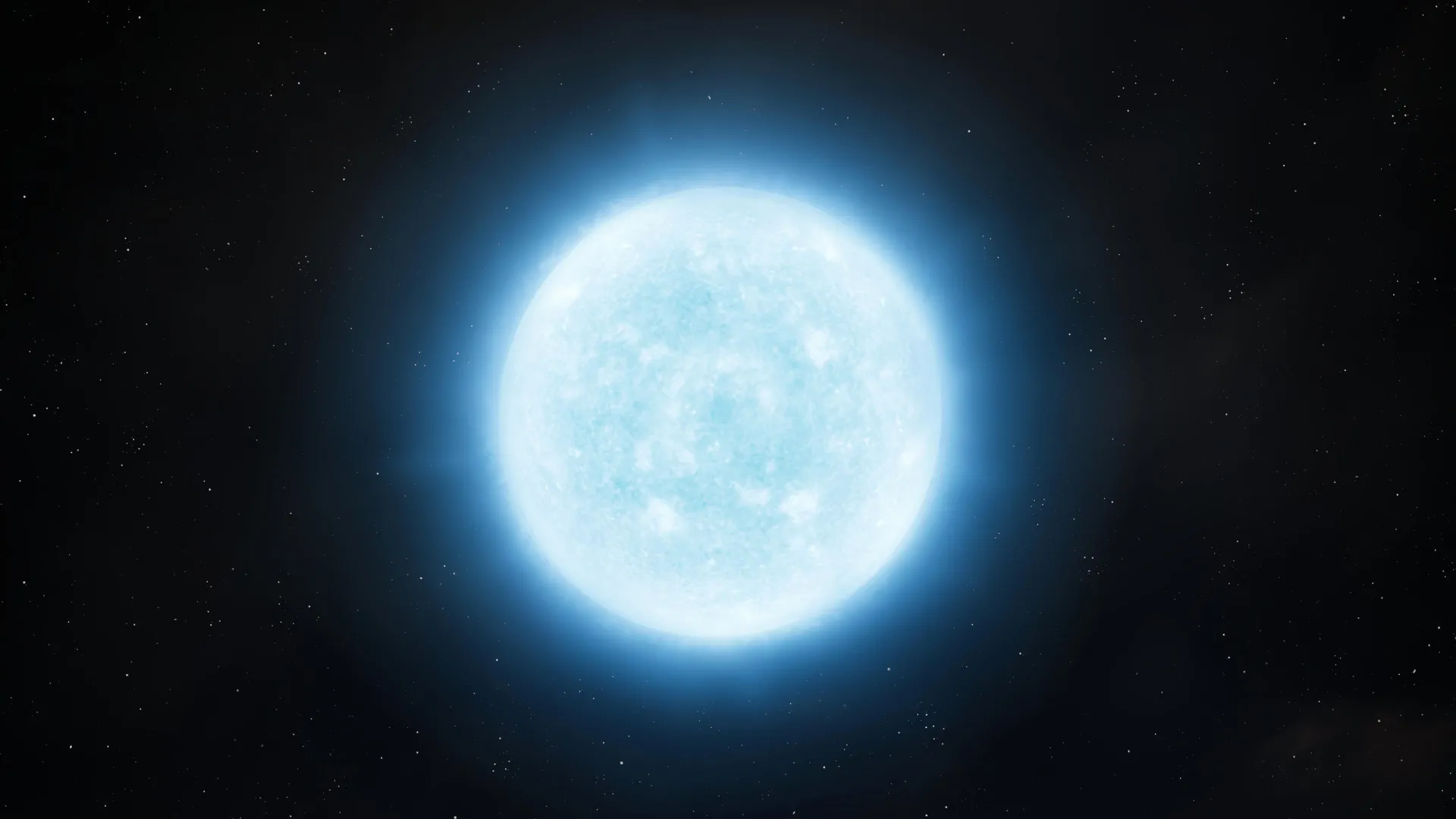
Some of the universe's dead stars may be capable of growing far more massive than a famous limit in physics was thought to allow. New computer simulations suggest that powerful magnetic fields hidden inside these stellar remnants could help them withstand crushing gravity and reach extraordinary masses. The discovery challenges a long-standing understanding of white dwarfs, the dense cores left behind when certain stars exhaust their nuclear fuel and shed their outer layers.
Although these stellar remnants are roughly the size of Earth, they can contain as much mass as the Sun or even more. For white dwarfs without strong magnetic fields or rapid rotation, physicists have long recognized an upper mass boundary of approximately 1.4 times the Sun's mass. Known as the Chandrasekhar limit, this threshold plays an important role in understanding how some stars end their lives in spectacular explosions.
When a white dwarf made primarily of carbon and oxygen approaches this limit, the increasing pressure and density inside its core can ignite carbon, potentially setting off a powerful thermonuclear explosion known as a Type Ia supernova. Scientists Discover How Magnetic Fields Could Break a Famous Cosmic Limit New simulations by researchers from the Department of Physics at the Indian Institute of Science (IISc) and their collaborators suggest that the traditional mass limit may not apply to white dwarfs with sufficiently strong internal magnetic fields. In one simulation, a magnetized white dwarf reached approximately 2.4 times the mass of the Sun, substantially exceeding the conventional limit of 1.4 solar masses.
"The idea started in 2011, when a summer student came to me and I gave him a problem quite casually: to check whether the Chandrasekhar limit can be violated by a magnetic field," explains Banibrata Mukhopadhyay, Professor at the Department of Physics and corresponding author of the study published in The Astrophysical Journal Letters. The possibility of white dwarfs exceeding the Chandrasekhar limit is not entirely new. Theoretical physicists have explored these unusual objects, sometimes called "super-Chandrasekhar" white dwarfs, for decades.
Astronomers have also observed Type Ia supernovae that shine much more brightly than expected. These exceptionally luminous explosions have raised the possibility that some white dwarfs may reach masses as high as 2.8 times that of the Sun before exploding. However, demonstrating that such massive white dwarfs could theoretically exist is only part of the challenge.
Scientists also need to explain how an ordinary star could naturally develop into one. Following a Star's Evolution From Birth to Death "The important question was not simply whether a super-Chandrasekhar white dwarf is possible, but whether a star can actually evolve into one," says Zenia Zuraiq, first author of the study and PhD student at the Department of Physics. "Our simulations allowed us to follow that evolutionary pathway from the main-sequence star to the white dwarf, and show that under certain conditions, such a pathway is possible." To investigate this process, the researchers modified a stellar evolution computer program called STARS, originally developed at the University of Cambridge.
Extract — continue reading at the source.


