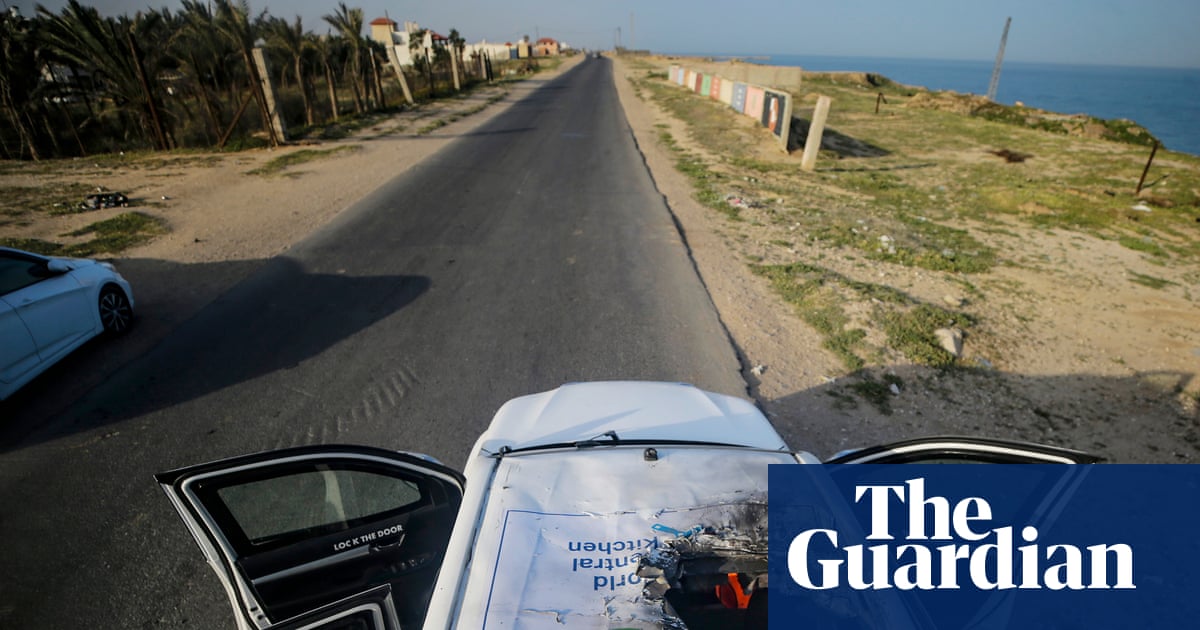
On the evening of 1 April 2024, a team of aid workers from World Central Kitchen (WCK) stood on Gaza’s Mediterranean shore overseeing the unloading of a barge full of desperately needed food on a makeshift jetty made of sand and rubble. The Gaza war had been raging for six months and Israel’s closure of land crossings had left the whole territory facing the threat of famine. WCK and local Palestinian contractors had constructed the jetty out of everything they could lay their hands on, including debris from the bombed house of one of the contractors, so that the pallets of humanitarian assistance could be delivered by boat from Cyprus.
A consignment of 200 tonnes of rice, flour and other proteins had arrived two weeks earlier, the first sea shipment to dock in Gaza since 2007. This was the second shipment and it was even bigger, with enough food to prepare more than 1m meals, as well as a Ramadan gift of dates from the United Arab Emirates. The choreography of the delivery had been coordinated over several days with the Israeli army, and an officer was on the jetty to observe the proceedings.
In the midst of a devastating bombing campaign after the Hamas attack on Israel in October 2023, this humanitarian effort was supposed to be carried out under internationally agreed military protection. The shipment had been unloaded by 8.30pm but despite the lengthy planning, there was a delay in receiving final Israeli security clearance for the eight hired trucks and two WCK escort vehicles to leave the jetty. By the time the green light came from local Israeli commanders and the convoy began to move south, night had fallen.
There was no initial overhead surveillance but two drones joined somewhere along the route to the first stop, a WCK welcome centre 6 miles to the south. Those drones were assigned to the Israel Defense Forces’ (IDF) Nahal brigade, which had not been fully briefed on the aid convoy’s itinerary. A special adviser assigned by the Australian government to assess the case (in the interests of justice for the Australian victim Lalzawmi Frankcom), found that “specific details about the pre-coordinated WCK aid mission had not been passed down from higher levels of Southern Command to the brigade and UAV [unmanned aerial vehicle] operator”.
At the WCK welcome centre, a few local men hired as guards were waiting, at least one of them armed. At a time of widespread hunger, many food convoys had been mobbed by desperate crowds as well as organised gangs, some of whom may have had been linked to Hamas, though Hamas never had the grip on food deliveries alleged by the Israeli authorities. Using local security for aid deliveries was not unknown in Gaza, but it was directly against WCK policy to use armed escorts.
The WCK says it is unclear why the local team on that night agreed to accept armed guards. The official Israeli version of events suggests it was “due to the convoy’s delayed departure, during night-time hours,” and noted it “was not coordinated with IDF authorities”. The official Israeli version does not say how many armed men were waiting for the convoy (unofficial versions vary between two and four), but drone footage reportedly showed one of them climb on top of the cabin of one of the trucks and fire a shot in the air shortly afterwards, for reasons that remain unknown.
Extract — continue reading at the source.