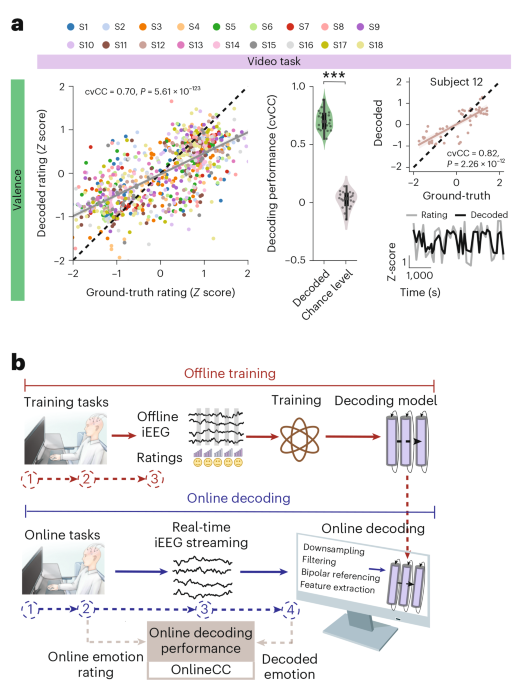
By integrating intracranial neural signals from gray and white matter, we developed personalized deep learning models that accurately decoded continuous valence and arousal states across image and video viewing tasks. The models generalized across tasks, revealed emotion-encoding brain subnetworks and enabled low-latency real-time decoding, bringing affective brain–computer interfaces closer to being suitable for closed-loop therapy. This is a preview of subscription content, access via your institution Access Nature and 54 other Nature Portfolio journals Get Nature+, our best-value online-access subscription Receive 12 digital issues and online access to articles Prices may be subject to local taxes which are calculated during checkout Kabotyanski, K.
Intracranial neural biomarkers of psychiatric symptoms and their utility for guiding neuromodulation therapy: a systematic review. Psychiatry https://doi.org/10.1016/j.biopsych.2025.10.005 (2025). A review article that discusses intracranial neural biomarkers of psychiatric symptoms and their utility for guiding neuromodulation therapy.
Mood variations decoded from multi-site intracranial human brain activity. Biotechnol. 36, 954–961 (2018). This paper provided early evidence that mood-state variations can be decoded from distributed intracranial recordings in humans.
Invasive neurophysiology and whole brain connectomics for neural decoding in patients with brain implants. This paper demonstrated emotion decoding from invasive recordings in patients with treatment-resistant depression who were undergoing deep brain stimulation and identified network targets for affective-state decoding. Closed-loop neuromodulation in an individual with treatment-resistant depression.
Med. 27, 1696–1700 (2021). This paper demonstrated closed-loop neuromodulation guided by a personalized biomarker in a patient with treatment-resistant depression. Cingulate dynamics track depression recovery with deep brain stimulation.
Nature 622, 130–138 (2023). This paper reported explainable neural biomarkers that track depression recovery during subcallosal cingulate deep brain stimulation. Publisher’s note Springer Nature remains neutral with regard to jurisdictional claims in published maps and institutional affiliations.
Extract — continue reading at the source.


