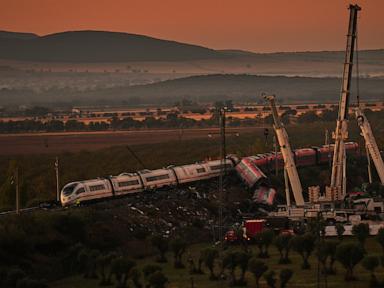
Spain began three days of mourning on Thursday after its second high-speed rail collision this year killed 68 people and injured scores, with relatives desperately seeking news about their loved ones. One of Europe's deadliest train disasters this century has raised fresh questions about safety on Spain's rail network after the transport minister reported an "error" and "inexplicable circumstances" that led to the crash. The collision happened in the central region of Castilla-La Mancha on Wednesday morning when a service by state operator Renfe ploughed into the back of a stationary train belonging to private Spanish company Iryo.
To display this content from YouTube, you must enable advertisement tracking and audience measurement. One of your browser extensions seems to be blocking the video player from loading. To watch this content, you may need to disable it on this site.
Cover image: Los servicios de emergencia trabajan en el lugar de una colisión entre dos trenes de alta velocidad en Urda, España, el miércoles 28 de octubre de 2026. © Manu Fernandez / AP Emergency services combed through the wreckage at night to find further victims on the key line linking Madrid with the southern city of Seville, hoisting pieces of mangled metal with cranes, reporters saw. Josimar Medina, a 31-year-old Peruvian who was holidaying in Spain with his girlfriend, said he was sleeping on the Renfe train when "I woke up and I was in the air." Pablo Mejia, 42, escaped with injuries to his head, saying that a last-minute change of seat saved his life. Wearing a bloodstained grey jumper and holding his tattered suitcase, he recounted "a very strong hit... a lot of people on the floor, on top of each other, seats ripped out, suitcases, a lot of chaos".
A school in the nearby village of Urda, around 130 kilometres (80 miles) south of Madrid, is being used to allow relatives to enquire about their loved ones. Read moreSpain to observe three days of mourning after scores killed in high-speed train collision Teams of Red Cross workers offered support to groups of people who arrived, some of them in tears, amid crowds of police and journalists from around the world. Red Cross psychologist Carmen Garcia said "long and hard hours" were in store because "every person will manage it in their own way.
"We have people who are in shock, who haven't taken on board what has happened, angry people, sad, worried people. The grieving will be complicated," Garcia said. The Civil Guard has set up four offices in the cities of Madrid, Toledo, Cordoba and Seville to enable relatives of the victims to provide DNA samples and help identify the missing.
Blood donation points have also been set up in Castilla-La Mancha and Madrid. Jose Miguel Fernandez, a parish priest in Urda, joined the emergency services in offering support to the victims' families. "What matters most is being with the victims' relatives, that they feel the closeness, because words at a time like this are pointless, but a hug helps," he said.
Extract — continue reading at the source.