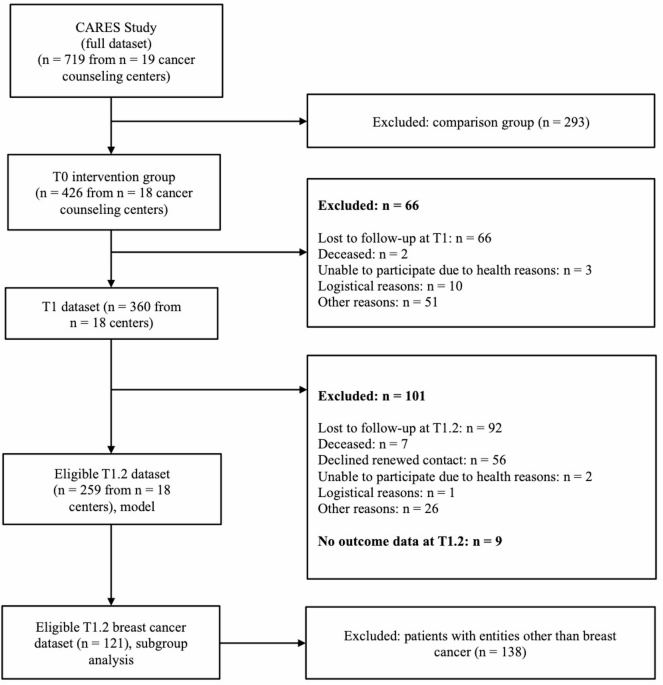
A prognostic model was developed and internally validated to predict satisfaction with the occupational situation among cancer patients receiving psychosocial counseling regarding return to work (RTW). Data were collected from outpatient cancer counseling centers in Germany and included individuals who had sought counseling on work-related issues at different stages of their illness. Satisfaction with the occupational situation was measured using a single-item scale.
LASSO regression with cross-validation and bootstrapping was applied for predictor selection. The final model (n = 259) identified satisfaction with life, baseline satisfaction with the occupational situation, and higher household and personal income as positive predictors, while workplace conflicts and psychological distress were negative predictors. The model showed moderate predictive accuracy (R2 = 0.29, RMSE = 2.55) and good calibration-in-the-large (predicted: 5.45; observed: 5.45).
The model may support the identification of cancer survivors likely to report low satisfaction with the occupational situation following psychosocial counseling. External validation is required to assess generalizability. A web-based tool was developed to support application in counseling settings.
We would like to sincerely thank all patients who participated in this study. We are also grateful to Leben nach Krebs e.V. for their valuable contribution as a patient self-help and advocacy organization. We thank the Working Group Social Work in Oncology (ASO) of the German Cancer Society for their contribution to the development of the intervention, and the CARES consortium for their collaboration and involvement.
Our thanks also go to the German Federal Pension Insurance for funding the CARES project, in which this analysis was conducted. No specific funding was received for this manuscript. The underlying CARES research project is funded by the German Federal Pension Insurance (Deutsche Rentenversicherung Bund; Grant number: 8011-106-31/31.128.1).
German Cancer Society (Deutsche Krebsgesellschaft e. V.), Berlin, Germany Hannah Lange, Rebecca Roth, Nora Tabea Sibert, Clara Breidenbach, Sophie Klara Schellack & Christoph Kowalski Institute of Public Health, Charité-Universitätsmedizin Berlin, Berlin, Germany Oncological Health Services Research with a Focus on Digital Medicine, Department of Gynecology and Obstetrics, Düsseldorf University Hospital, CIO Düsseldorf, Düsseldorf, Germany Centre for Digital Medicine, Heinrich Heine University Düsseldorf, Düsseldorf, Germany Chair of Health Services Research, Institute of Medical Sociology, Health Services Research and Rehabilitation Science, Faculty of Medicine and University Hospital Cologne, University of Cologne, Cologne, Germany Clara Breidenbach, Nicole Ernstmann, Paula Heidkamp, Kati Hiltrop, Jannika Rother & Lina Heier Center for Health Communication and Health Services Research, Department of Psychosomatic Medicine and Psychotherapy, University Hospital Bonn, Bonn, Germany Nicole Ernstmann, Paula Heidkamp, Kati Hiltrop & Lina Heier Interdisciplinary Center for Palliative Medicine, Medical Faculty, University Hospital Düsseldorf, Heinrich Heine University Düsseldorf, Düsseldorf, Germany Center for Integrated Oncology Aachen-Bonn-Cologne-Düsseldorf (CIO ABCD), Düsseldorf, Germany The authors Hannah Lange, Rebecca Roth, Nora Tabea Sibert, Clara Breidenbach, Sophie Klara Schellack, and Christoph Kowalski are employed at the German Cancer Society, where the study was conducted. Tobias Kurth reports having received research grants from the German Federal Joint Committee (G-BA) and personal compensation from the North-East German Society for Gynecological Oncology (NOGGO), AbbVie, the BMJ Group, and Frontiers Media S.A.No specific funding was received for this manuscript.
Extract — continue reading at the source.


