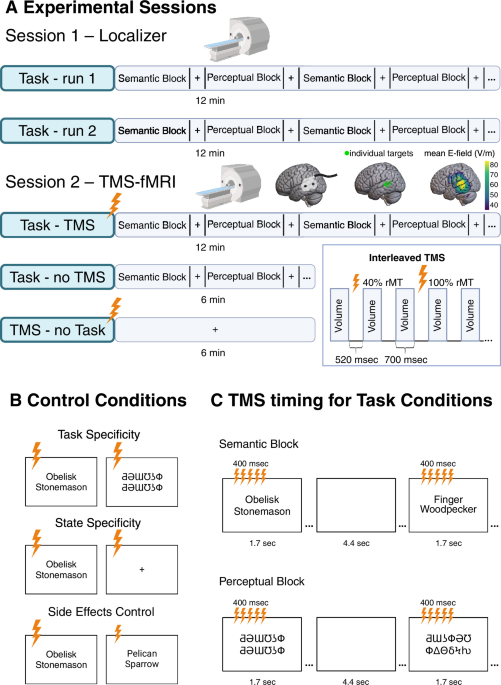
Semantic processing relies on flexible interactions between specialized lexico-semantic regions and domain-general control networks, particularly under challenging conditions. Using transcranial magnetic stimulation interleaved with functional magnetic resonance imaging, we investigated acute network adaptation when the left posterior middle temporal gyrus—a core lexico-semantic region—was perturbed during lexico-semantic decisions in 25 healthy participants. High-intensity transcranial magnetic stimulation over the posterior middle temporal gyrus induced task-specific activity increases across semantic control and lexical retrieval areas, as well as remote domain-general regions.
Critically, increased local activity at the stimulation site correlated with slower reaction times, whereas greater upregulation in domain-general frontal regions was associated with less disrupted semantic performance. These findings indicate that acute semantic disruption triggers immediate, flexible recruitment of domain-general control areas consistent with the maintenance of task performance, highlighting the brain’s capacity to dynamically adapt to interference. Our findings contribute to the current understanding of putative compensatory network-level mechanisms supporting lexico-semantic cognition.
Fluent semantic processing is a key faculty for language comprehension and production, storing and retrieving long-term information from memory and drawing inferences from contextual knowledge. Previous neuroimaging, lesion and neurostimulation studies have provided insight into the underlying neural circuits in the human brain1,2,3,4,5. These studies demonstrate that challenging situations such as noisy listening conditions and demanding tasks increase the contribution of the semantic control network6,7,8.
This network comprises, among other regions, the left anterior inferior frontal gyrus (aIFG) and posterior middle temporal gyrus (pMTG;1,9,10,11,12). While the aIFG is crucial for resolving high-demand or conflicting semantic conditions, the pMTG has been associated with the controlled retrieval of semantic concepts and lexical retrieval (e.g., refs. 8,13,14,15). Notably, semantic control requires both the controlled retrieval of semantic concepts and the ability to solve conflicting semantic information1.
Other work demonstrated that higher cognitive demands require flexible interactions between regions involved in general semantic processing, semantic control regions and domain-general areas of the multiple demand network (MDN;6,16). The MDN is central to executive processing and supports functions such as task set maintenance, attentional allocation, and response conflict resolution. Beyond increasing task demands, brain lesions in semantic areas often severely impair semantic cognition.
Several studies showed that recovery of language function does not only rely on the specialized language network but also engages multiple demand regions (e.g., refs. 17,18), especially during early recovery from stroke-induced language impairments19,20. Accordingly, we have recently argued that focal damage to domain-specific semantic areas may be partially compensated for by flexible recruitment of domain-general areas of the MDN21. Such increased contributions may support maintenance of specialized functions under challenging conditions in young and older brains22 and recovery of function after lesions20.
Extract — continue reading at the source.


