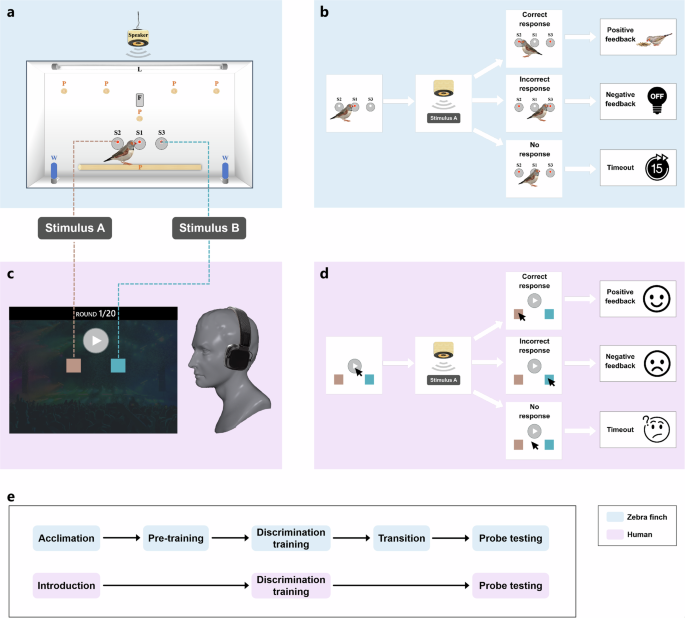
Deriving sequential information from complex sounds is a challenge for auditory systems, yet it remains unclear whether humans and nonhuman species integrate multidimensional cues or prioritize a single dimension when processing multidimensional input. We investigated how humans and zebra finches (Taeniopygia guttata) process concurrent acoustic cues using an identical behavioural paradigm with complex-tone sequences. By presenting probe stimuli that selectively preserved or disrupted either pitch or formant trajectory, we quantified these processing strategies.
We show that zebra finches employ an additive integration strategy, treating pitch and formant trajectories as complementary components of a unified auditory pattern. In contrast, humans exhibit a dominant reliance on pitch. Experience further modulates this bias, with trained human listeners recruiting secondary cues to preserve learned relational structure when pitch is unreliable.
These findings imply a cross-species divergence in auditory representation, suggesting that auditory processing is shaped by an interplay of species-specific priorities and experience-dependent functional substitution. Music and speech share core organizational principles: both comprise systematically ordered sequences of acoustic events whose structure is supported by perceptual dimensions such as rhythm, pitch, and timbre1. Recent neuroimaging work has sharpened the spectrotemporal distinctions between these domains and revealed hemispheric asymmetries in sensitivity to spectral versus temporal modulation2,3,4.
Although subcortical circuits may provide a common substrate for encoding basic acoustic dimensions across domains, higher-level cognitive processing diverges with functional demands. For instance, in speech, two key dimensions—pitch and formant—carry communicative and linguistic information (e.g., prosody and vowel identity), whereas in music these same acoustic dimensions function as abstract fundamental frequency- and timbre-based structures that support melodic and timbral organization2,5,6. Importantly, sensitivity to pitch- and formant-related structure is not uniquely human: both dimensions contribute to vocal communication across diverse animal taxa7,8,9.
Moreover, growing evidence indicates that perceptual categories such as “pitch” and “timbre” do not map transparently across species, motivating renewed attention to the underlying spectral percepts that listeners actually exploit10. The central unresolved issue is whether flexible integration or segregation of concurrent acoustic dimensions—depending on context and task demands—reflects a general property of auditory processing or, instead, a specialization shaped in humans by extensive experience and cultural exposure. Addressing this question demands comparative experiments that directly assess how humans and other vocal learners11, including songbirds, prioritize and combine pitch and formant contours, particularly when these cues vary in their congruence.
Pitch is conventionally defined as the perceptual correlate of a sound’s fundamental frequency (f₀)12. However, human listeners can also track spectral regularities and melodic contour in ways that do not require an explicit estimate of f₀13,14. For harmonic sounds, component frequencies are typically integrated into a single perceptual object15, and “melodic” structure can be supported by contours in other dimensions, including loudness and brightness13.
Extract — continue reading at the source.



