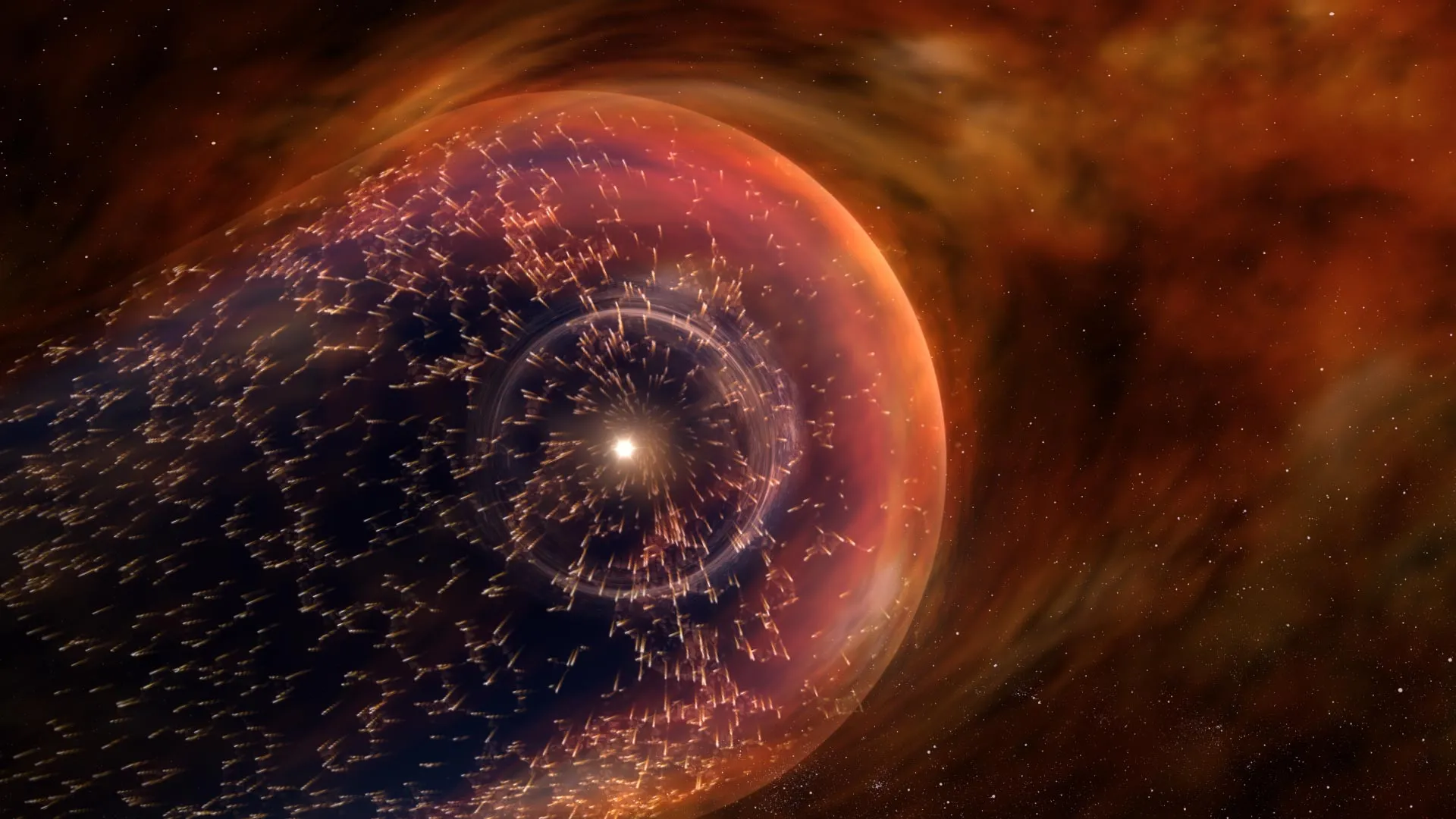
The Sun does far more than provide Earth with light and heat. Two recent NASA-funded studies suggest that events from the Sun's distant past may have influenced Earth's climate in unexpected ways, from helping drive ancient temperature shifts to keeping the young planet warm enough for liquid water and possibly life. One study from NASA's SHIELD (Solar Wind with Hydrogen Ion charge Exchange and Large-Scale Dynamics) center, one of NASA's DRIVE (Diversify, Realize, Integrate, Venture, Educate) Science Centers, examines how the heliosphere moved through the Milky Way over time.
The heliosphere is the vast protective bubble produced by the Sun that surrounds the solar system. Researchers found that changes in the galactic environment around this bubble may have affected conditions on Earth. A separate study led by a NASA scientist explores another ancient puzzle: how a much dimmer young Sun could have kept Earth warm.
The findings suggest that powerful solar eruptions may have helped generate strong greenhouse gases in Earth's early atmosphere. Earth's climate has changed dramatically over tens of millions of years. At various points, major ice ages temporarily lowered global average temperatures by several degrees, while other periods brought repeated swings between warmer and colder conditions.
Scientists have traditionally investigated changes in Earth's orbit, greenhouse gas levels, ice coverage, and other planetary factors to understand these shifts. New research now suggests that changes in the space environment surrounding the Sun may also have played an important role. The solar system is enclosed within a protective region created by the Sun, somewhat like the way Earth is surrounded by an atmosphere.
This region, called the heliosphere, forms as charged particles in the solar wind continuously stream outward from the Sun in every direction. The entire heliosphere travels around the center of the Milky Way. During the Sun's 4.6-billion-year lifetime, the solar system has moved through many different galactic environments.
In a study published on Aug. 21 in Annual Review of Astronomy and Astrophysics, researchers with NASA's SHIELD center used computer simulations to reconstruct the heliosphere's past trajectory through the galaxy. Their results suggest that some of the regions the solar system encountered may have produced measurable changes on Earth. Merav Opher, SHIELD's principal investigator at Boston University, and her colleagues simulated encounters between the solar system and extremely cold regions filled with gas and dust.
Extract — continue reading at the source.


