Imagine opening a history book and finding several chapters torn out. This was what geologists looking into the rock records of Earth’s past discovered on several continents in the 1870s. They dubbed it the Great Unconformity.
Where layers of rock often stack up in a steady sequence from oldest to youngest, in many places around the world there is a gap of hundreds of millions of years. For 150 years, nobody has known what erased those missing chapters. In new research published today in Nature, we finally provide an explanation: deep processes inside Earth lifted some continents high above the sea, where their surfaces were scoured down by the grinding movement of enormous sheets of ice.
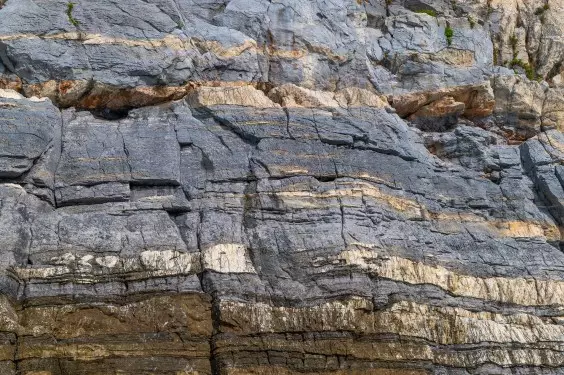
Layers of rock often stack up in chronological order, with the oldest at the bottom and the youngest at the top. Yet in some places, such as the Grand Canyon in North America, you can touch rock layers from two different ages, hundreds of millions of years apart. A flat layer of sedimentary rock, about 540 million years old or younger, rests directly atop a crystalline “basement” up to two billion years old.
Somewhere in between, a considerable chunk (up to a quarter) of Earth’s history has simply vanished. Important things happened in that time. The sedimentary layers on the younger side of the Great Unconformity appear at the same time as a huge diversification in the forms of life on Earth.
This is the so-called Cambrian explosion, which began around 540 million years ago. Scientists have speculated entire continents were eroded during the Great Unconformity, which may have altered the chemical balance of seawater and allowed animal life to flourish. Geologists have found evidence of the Great Unconformity throughout North America and parts of northern China, as well as beneath younger rocks in northern Europe.
Yet its origin has remained a puzzle. Some scientists have argued it was caused by erosion by massive ice sheets during the Snowball Earth period between 720 million years and 635 million years ago. Others have pointed to the reshuffling of continental blocks, mountain-building processes, heat-induced movement inside the Earth, volcanic activity, or global sea level change.
Extract — continue reading at the source.