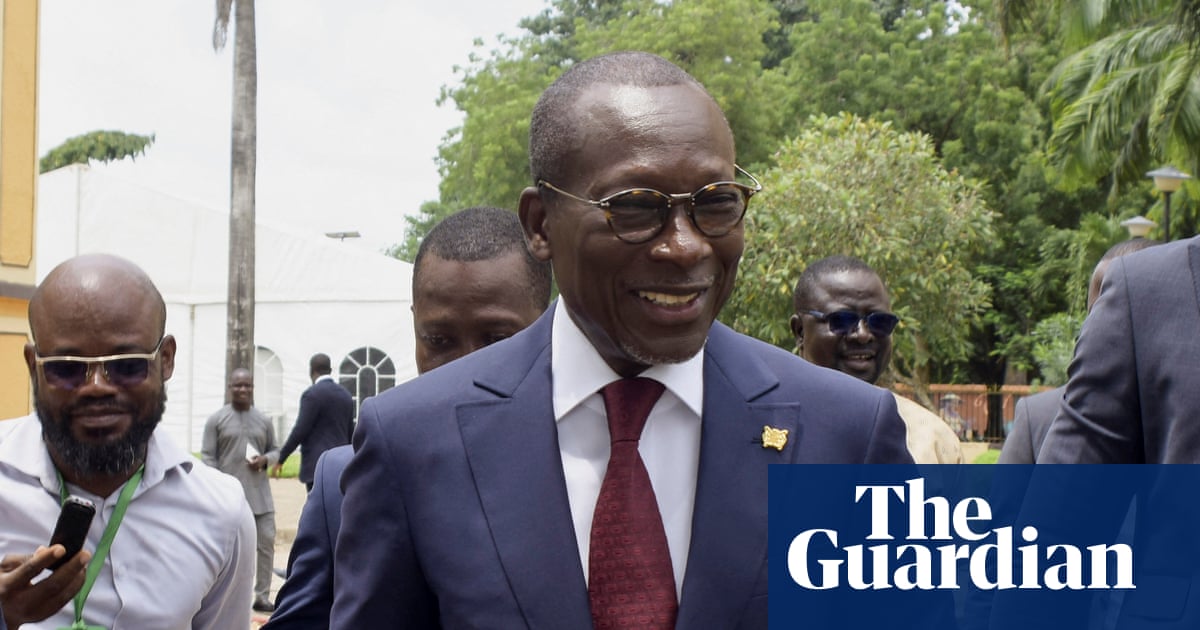
In recent years, a building boom has reshaped Benin’s largest city, Cotonou, and a shiny new coastal road has reduced journey times to Ouidah, the west African country’s spiritual and cultural capital. In the last decade, Benin’s annual GDP has grown from 3% to 6%, a regional high, and an industrial zone has been launched north-west of Cotonou to help industrialise the relatively small nation’s largely informal economy. The rapid infrastructural development has been overseen by Patrice Talon, the president from 2016 till this May.
For years, Benin was so content being in the shadow of Nigeria, a neighbour about eight times its size and with about 16 times its population, that Talon’s predecessor, Thomas Boni Yayi, once quipped during a visit to Abuja that “Benin is the 37th state of Nigeria”. Talon, who also enjoys good relations with Nigeria and called on it to help quell an attempted coup d’etat in December, chose a different path: to engineer enough growth for Benin to be recognised in its own right. Widely believed to be Benin’s richest person, Talon, known as “the cotton king”, made his name in agriculture but diversified into banking and hospitality.
Before becoming president, he had financed the campaigns of Yayi and Yayi’s predecessor, Mathieu Kérékou. Critics say his development agenda has come at a severe cost: once held up as a poster child for democratic transition in west Africa, Benin has also undergone democratic decline since Talon took power. In many respects, Talon modelled his governance style on the leader of another relatively small African country: Paul Kagame.
The archetypal “benevolent strongman”, Rwanda’s de facto leader since 1994 has also combined repression with policies aimed at economic and social transformation. In time, the two men became allies and Talon even appointed two former Rwandan officials to head sensitive Beninese government agencies. Benin has also sought the east African nation’s help in countering a growing insurgency along the border with Nigeria.
By the end of Talon’s first term, strict new election laws and heavy registration fees had purged a lot of the opposition from parliament. In 2019, the government shut down the internet during a parliamentary election as people protested against the changes. The judiciary was co-opted to muzzle dissent, resulting in the targeting of several dozen former allies and dissidents, including the opposition leader Reckya Madougou, who is in prison on charges of “undermining the state”, and the journalist Hugues Comlan Sossoukpé.
In April 2021, a month after Madougou’s arrest, Essowé Batamoussi, a judge at the court for the repression of economic offences and terrorism, resigned his post and fled to France to seek asylum. A controversial constitutional amendment, the second of his tenure, elongated the presidential term from five years to seven and introduced thresholds that kept opposition parties outside parliament. It also created a new senate, whose members are all appointed by government rather than elected.
Extract — continue reading at the source.