Digital mental health interventions show promise but have yet to meet expectations. We discuss gaps between promising results of pilot studies and null findings in randomized controlled trials, focusing on two major approaches: just-in-time relapse prevention and just-in-time adaptive interventions. We propose that relapse prevention will profit from long-term studies capturing emerging episodes, and we suggest a novel framework for adaptive interventions including causality testing to proceed towards effective trialing.
The WHO expects digital interventions to address current healthcare challenges and to transform health prevention and treatment1. For mental health, digital interventions reveal opportunities beyond scalability. First, mental health conditions often include harmful behavior as core classification criteria and starting point for interventions, such as alcohol consumption or avoidance behavior.
Behavioral techniques, delivered via digital interventions2, can therefore directly address mental health. Second, symptoms of mental disorders are context-dependent. They often emerge in specific contexts and fluctuate over time; therefore, symptoms should be assessed and treated in relevant environmental contexts3.
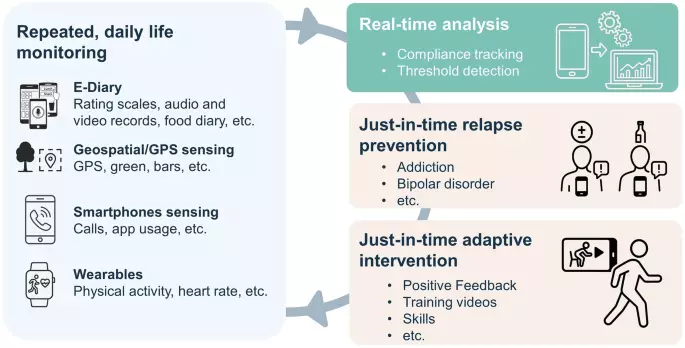
For example, ‘morning depression’ can best be captured at a certain time, and anxiety can be reduced in a safe therapy environment. Fortunately, mental mobile Health (mental mHealth) interventions have been tremendously benefitted by technological progress across the last decades. Figure 1 illustrates the key methodological environment for mental mHealth interventions, which we call “mHealth toolbox”.
Symptoms and contexts relevant for putative interventions can be tracked in daily life using smartphones and wearables and, importantly, they can be analyzed in real-time. The mHealth toolbox comes with two unique chances: First, there is just-in-time relapse prevention, whereby situations of high mental health risk can be detected early, such as emerging depressive or manic episodes. External help can then be delivered in time, e.g., adaptations in pharmacological treatment, to prevent new episodes of illness4.
Second, there are just-in-time adaptive interventions, which trigger micro-treatments such as mindfulness interventions to decrease momentary craving for alcohol, after detecting moments when participants might be especially susceptible to behavior change techniques. Just-in-time relapse prevention and just-in-time adaptive interventions draw from the mHealth toolbox and make use of repeated, daily life monitoring and real-time analysis. However, they are aiming for distinct goals.
Extract — continue reading at the source.