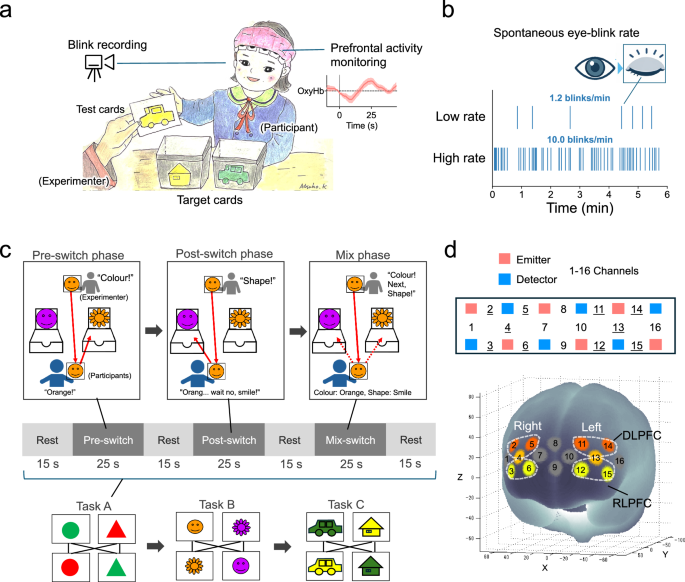
Executive function develops rapidly in early childhood and predicts later success in life, yet its neurobiological correlates during this period are not yet well characterised. In adults, executive function is supported by prefrontal–striatal circuits under neuromodulatory control, including dopamine. Here, we show that spontaneous eye-blink rate, a physiological output influenced by neuromodulatory systems, is associated with the developmental trajectory of executive function and prefrontal functional differentiation.
We used fNIRS to monitor prefrontal cortex (PFC) activation in 113 children (35–80 months) during a cognitive flexibility task. Older children showed better task performance and greater right-hemisphere and dorsal bias in their PFC activation. Importantly, higher eye-blink rate was also associated with this right-dorsal PFC activation and with better task performance.
The current findings demonstrate that emergent eye-blink rate is associated with the neural origins of executive function development in young children. This highlights the potential of eye-blink rate to serve as a unique and previously unrecognised indicator of this critical developmental neural mechanism. Executive function—the higher-order cognitive processes enabling goal-directed behavior and self-control—is essential to quality of life and is an important factor predicting academic achievement, social adjustment, and health across the lifespan1,2,3.
Executive function starts to develop during infancy, showing rapid changes during preschool years, and continues to develop through adolescence and into adulthood4,5. This trajectory is thought to reflect the functional maturation of the prefrontal cortex (PFC) and associated neural networks6,7,8. According to a prevailing working hypothesis, task-related PFC activation shifts with age—from diffuse, widespread engagement in early childhood to more focal, specialized configurations that rely on efficient networks with other brain regions in later development9,10,11.
This transition signifies a functional differentiation of neural recruitment, marking the refinement of prefrontal organization. However, it remains unclear whether this functional reorganization already begins to emerge during the preschool years and what neural mechanisms might modulate it12. In adults, executive function is controlled by neuromodulatory systems, including dopaminergic tone.
Accumulating evidence demonstrates that the dopaminergic transmission originating in the midbrain is linked with executive function via function in the dorsolateral PFC (DLPFC) and striatum, which is to say the frontostriatal networks13,14. Dopamine projections to the PFC are thought to enhance the signal-to-noise ratio of neural representations15, stabilizing goal-relevant information, whereas dopaminergic input to the striatum acts as a gate that enables selective updating of task rules16,17,18. Given its critical involvement in both cognitive switching and updating in adults, basic maturation in these circuits may also contribute to the rapid emergence of executive function and efficient cortical recruitment during early childhood.
Extract — continue reading at the source.


