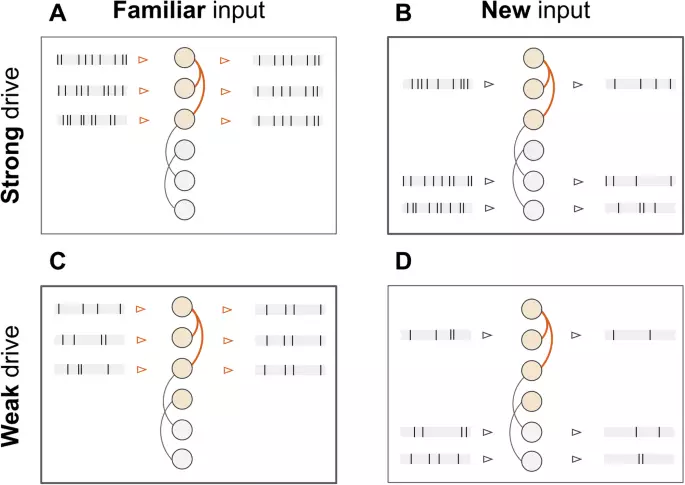
Whether neural computation relies on firing rate or spike timing has been debated for decades, with no definitive resolution. Here, using a recurrent spiking network simulation and realistically varying input drive, we demonstrate that the two mechanisms are complementary: rate reliably detects stimulus class, while ensemble synchrony reliably detects stimulus familiarity. This division of labor is necessary: rate coding fails to distinguish novel strong-drive from familiar weak-drive stimuli, while synchrony succeeds.
We validate this complementary coding across a V1-like model and an abstract associative memory network, establishing robustness across connectivity regimes and memory loads. Moreover, when inputs are already temporally coordinated, e.g. through familiarity in a previous network layer, ensemble synchrony alone can encode both stimulus identity and familiarity. Is the firing frequency of action potentials sufficient to understand how neurons compute and communicate, or is the timing of individual spikes crucially important?
Rate codes offer compelling advantages: they reliably correlate with experimental stimuli and behavior1,2,3, are the basis of numerous theoretical and data-driven mean-field and plasticity analyses4,5,6, and approximate successful deep learning networks7. Yet these advantages come at a cost: rate codes typically require information to be accumulated across many spikes and long time windows. This limits the speed with which information can be extracted from neural activity and makes rate codes potentially inadequate to account for behavior on fast timescales8,9.
Timing codes can support rapid information transmission in the temporal structure of relatively few spikes, with coding schemes including the precise order of spikes10, time-to-first-spike in a stimulus response11, rhythmic oscillations12, bursting patterns13, and spike synchrony14. While spike train variability challenges the reliability of timing codes15, this variability may reflect meaningful recurrent interactions16 or be mitigated by the relative nature of timing codes17. Thus, whether and to what extent brains rely on timing or rate information remains a fundamental yet unresolved question in neuroscience.
Rather than viewing rate and timing as competing alternatives, we propose they encode complementary information about stimuli. We designed a stimulus detection task with two key challenges: encoding stimulus identity across different input drive levels and distinguishing familiar from unfamiliar stimuli. Here we focus on absolute or long-term familiarity, whether stimuli match established patterns in recurrent connectivity, rather than relative familiarity from recent exposure, as these involve distinct neural mechanisms18.
Two critical cases are particularly difficult but important to distinguish: weak but highly familiar stimuli and strong but unfamiliar stimuli. A faint rustle from a known predator or a loud, unknown sound might evoke similar firing rates yet require fundamentally different responses. While sensory representations are generally believed to be encoded in firing rates1,2,3, recent evidence suggests that long-term absolute familiarity manifests as spike synchrony emerging from strong recurrent connections19,20,21.
Extract — continue reading at the source.