Epilepsy is one of the most prevalent and disabling neurological disorders, affecting >50 million people worldwide. Beyond recurrent seizures, it is strongly associated with cognitive impairment, psychiatric comorbidities, reduced social participation, and a markedly increased risk of premature death. Although considerable advances in neuroimaging, pharmacology, and surgical techniques have expanded therapeutic possibilities, nearly one-third of patients remain refractory to current treatments, a challenge that highlights the pressing need for deeper mechanistic insights and innovative therapeutic strategies.
This review provides an integrated overview of recent progress in epilepsy research and treatment. At the molecular level, we examine how ion channel dysfunction, receptor abnormalities, and disrupted signaling pathways drive hyperexcitability. We highlight insights from genetics and acquired etiologies that illuminate disease heterogeneity.
We address prevailing hypotheses of drug resistance and potential biomarkers. We also emphasize the growing recognition of epilepsy’s close association with diverse comorbidities, where shared molecular pathways not only deepen our understanding of disease mechanisms but also highlight new therapeutic targets. Finally, we evaluate emerging therapeutic directions, including precision pharmacology, neuromodulation, gene and cell therapies, and metabolic approaches such as the ketogenic diet.
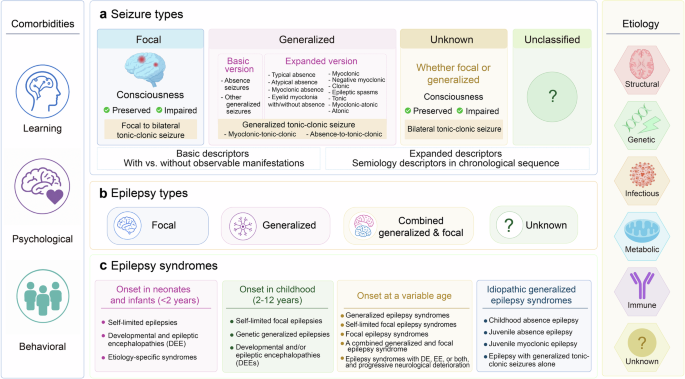
By bridging epidemiological perspectives with mechanistic discoveries and innovative therapies, this review underscores how advances in epilepsy research are reshaping the path toward precision medicine and improved patient outcomes. Epilepsy is among the most prevalent and disabling neurological disorders worldwide, with a global prevalence of ~1.0%.1 It affects individuals across all age groups and is associated with a threefold increase in premature mortality relative to that of the general population.2,3 Epilepsy is defined as an enduring tendency to generate epileptic seizures. An epileptic seizure is a transient alteration in behavior manifesting as objective signs or subjective experiences caused by abnormal, excessive, or synchronous neuronal discharges.4 Based on the 2025 International League Against Epilepsy (ILAE) latest definition, epileptic seizures are categorized as focal, generalized, unknown, and unclassified.4 Underlying etiologies span genetic mutations, structural etiology, infections, metabolic or immune-mediated disorders, and unknown.
Although epilepsy can occur at any stage of life, its clinical presentation, causes, and treatment priorities vary with age. In children, genetic epilepsies and developmental and epileptic encephalopathies (DEEs) are especially important because recurrent seizures may disrupt cognitive and behavioral development during critical developmental windows. In older adults, cerebrovascular disease, neurodegeneration, polypharmacy, and age-related pharmacokinetic changes complicate diagnosis and treatment.
In addition to seizures, epilepsy imposes considerable cognitive, psychological, and social burdens on patients and their families.5,6 Patients with epilepsy frequently experience a broad spectrum of neurological, psychiatric, and systemic comorbidities.7 Studies report that between 27% and 84% of individuals with epilepsy experience at least one medical comorbidity.8,9 Neuropsychiatric comorbidities are particularly prevalent and impactful. For instance, depression affects approximately 13.7% of adults with epilepsy. Beyond neuropsychiatric issues, peripheral somatic comorbidities are also common.
Extract — continue reading at the source.