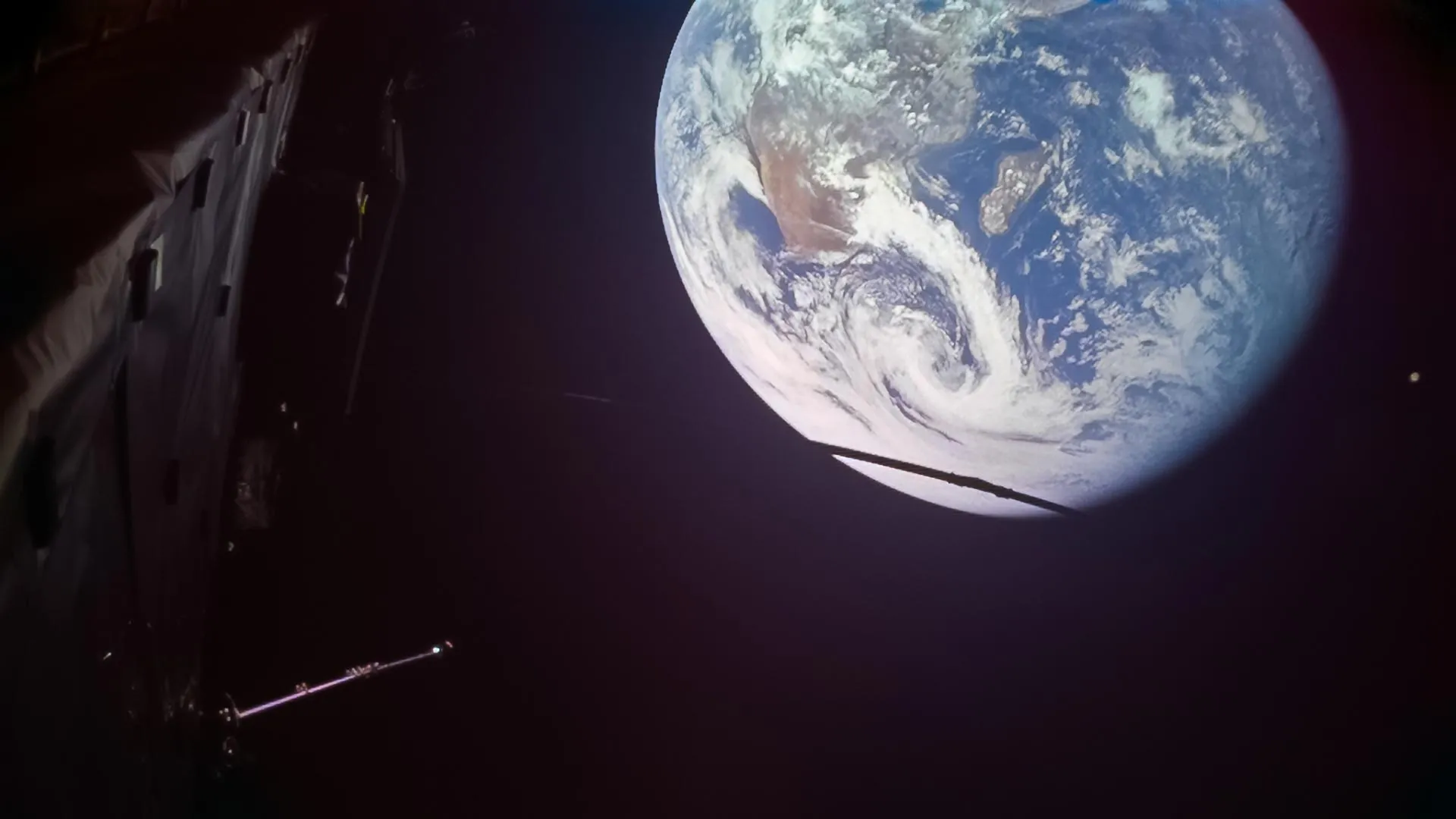
The European Space Agency's Jupiter Icy Moons Explorer (Juice) made a close pass by Earth on September 28, skimming the outer reaches of the atmosphere and using our planet's gravity to reshape its path toward Jupiter while consuming very little fuel. The carefully planned gravity assist changed Juice's direction by 20° relative to its previous trajectory and increased its speed by 3.5 km/s. During the four weeks leading up to the encounter, mission controllers needed to make only one small course correction (out of six opportunities set aside) to place the spacecraft on the precise approach needed to take full advantage of Earth's gravity.
Controllers began monitoring Juice particularly closely on August 17 and will continue that intensive tracking through October 10. Juice reached its closest point to Earth at ( ) on September 28. At that moment, the spacecraft passed just 8640 km above the Indian Ocean while taking a sequence of images with its onboard monitoring cameras.
"The flyby required ultra-precise navigation in real time. Thanks to our very careful planning, we used only a small amount of the propellant reserved for this flyby," says Angela Dietz, Juice's Spacecraft Operations Manager. "This gives us more to use at Jupiter to carry out observations of the planet's icy moons." Preserving that fuel is especially valuable because Juice will eventually need it while carrying out its ambitious scientific campaign around Jupiter and its moons.
Changing the spacecraft's trajectory was the primary purpose of the flyby, but the encounter also gave the mission team a valuable chance to test Juice's science instruments using a real planetary target. This was the third such opportunity during the mission. The first came during Juice's 2024 lunar-Earth gravity assist, followed by the spacecraft's 2025 observations of Comet 3I/ATLAS.
Teams from ESA's spacecraft operations, science operations and technical centers spent months coordinating with the outside groups responsible for Juice's 10 scientific instruments. Their goal was to carefully schedule when each instrument could operate and extract as much science and calibration time as possible from the spacecraft's limited resources. "Juice's journey to Jupiter provides only a few opportunities to calibrate and validate the instruments under well-understood environmental conditions," explains Juice project scientist Claire Vallat, who led the effort.
"Given the limited time available and operational constraints, instrument activities sometimes have to be prioritized, for example when Juice was in Earth's shadow this morning, and relying on battery power alone. During this flyby, calibration activities were prioritized based on their relevance to preparing the instruments for their work at Jupiter, while also considering whether an opportunity is unique or can be scheduled later in the journey." Although the Earth encounter required extensive preparation, it is relatively simple compared with what awaits Juice at Jupiter. The spacecraft is scheduled to carry out 35 flybys of the giant planet's large moons Ganymede, Callisto and Europa.
Extract — continue reading at the source.


