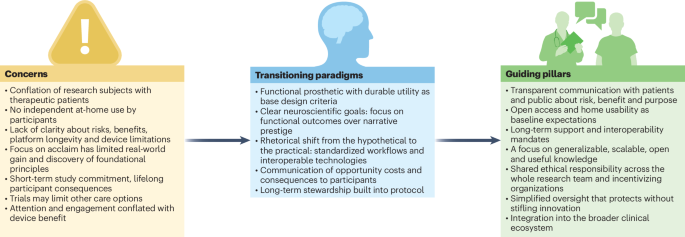
Implanted brain–computer interfaces hold great promise for restoring communication and other functions and for revealing new aspects of human brain physiology. Yet as the number of implantations in humans expands, ethical clarity must keep pace with technical ambition. We propose that this should involve distinguishing research participation from patient care, ensuring long-term support for study participants, ensuring that research participants do not bear disproportionate risks for benefits realized mainly by others, and grounding research in meaningful clinical purpose.
This is a preview of subscription content, access via your institution Access Nature and 54 other Nature Portfolio journals Get Nature+, our best-value online-access subscription Receive 12 print issues and online access Prices may be subject to local taxes which are calculated during checkout United States Government Accountability Office. Brain–Computer Interfaces: Applications, Challenges, and Policy Options https://www.gao.gov/products/gao-25-106952 (GAO, 2024). National Commission for the Protection of Human Subjects of Biomedical and Behavioral Research.
The Belmont Report: Ethical Principles and Guidelines for the Protection of Human Subjects of Research Vol. 2 (Department of Health, Education, and Welfare, 1979). Public Health 108, 1345–1348 (2018). Article PubMed PubMed Central Google Scholar Hendriks, S. et al.
JAMA Neurol. 76, 1506–1514 (2019). Neurosurgery 97, 277–280 (2025). Med. 391, 619–626 (2024).
Lancet Neurol. 17, 905–917 (2018). K., McLennan, S., Buyx, A. & Ienca, M. Brain Stimul. 17, 1145–1154 (2024).
Cardiol. 106, 810–818 (2010). Hastings Center Rep. 54, 24–33 (2024). Med. 31, 2850–2853 (2025).
Extract — continue reading at the source.