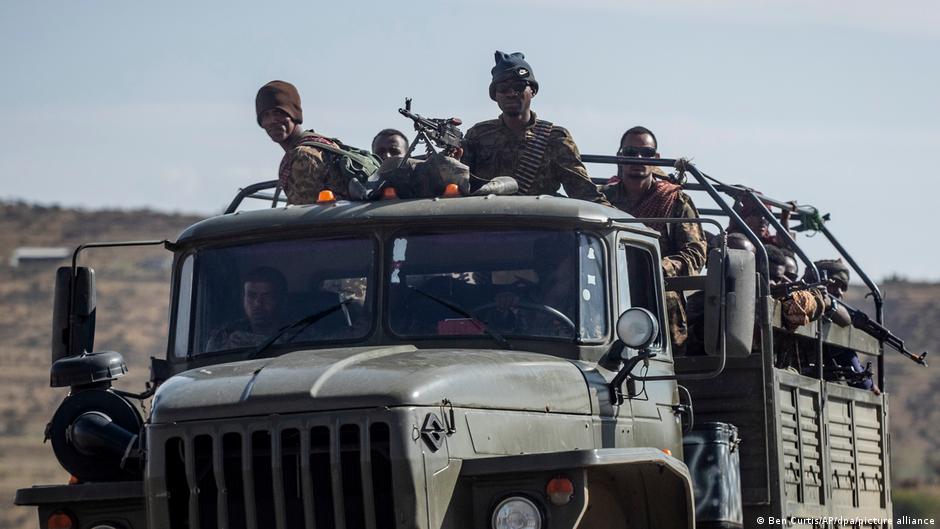
Just four years after a landmark peace deal officially halted the devastating Tigray war, fighting has escalated once again in northern Ethiopia in recent weeks. Just days before full-scale fighting resumed, several armed groups which had previously considered each enemies formally announced an alliance with a common goal: To bring down Prime Minister Abiy Ahmed's federal government. But this time, the lay of the land looks quite different from the previous conflict: Parties outside the country have been accused of meddling in the situation, with each having their own motives to want to destabilize Abiy's government.
This has raised fears about prolonged instability hitting the Horn of Africa. The 2022 Pretoria Peace Agreement ended the conflict between the Ethiopian federal government and the Tigray People's Liberation Front (TPLF), which cost hundreds of thousands of lives in the course of two years. Negash Mohammed, a journalist with DW's Amharic department. believes that the deal collapsed for three key reasons — or rather because three key actors in the conflict were largely neglected at the negotiation table.
Mohammed explained that the ultimate agreement didn't factor in the role of Eritrea in the conflict, which had fought alongside Ethiopia against the TPLF; it ignored the part that Amhara militias — known as Fano — played in the war, who later felt sorely excluded from the negotiations; finally, it ignored harliners within the TPLF who viewed the peace peace as nothing but military defeat. Tensions between the federal government and the Fano escalated further when Addis Ababa moved to forcibly disarm the militias instead of addressing their grievances. "The federal government has its own shortcomings," said Mohammed.
"Instead of convincing the other side, it went on to aggravate the grievances they [already] had." Mohammed also emphasized the fact that this coalition against the federal government includes several groups which have otherwise little to do with each other. It includes the Oromo Liberation Army, a faction of the Ogaden National Liberation Front as well as multiple smaller armed groups from the western Benishangul-Gumuz region — in addition to ethnic militant factions from Afar, which borders Tigray. Eritrea meanwhile appears to have shifted sides in the current situation: While not officially a member of the alliance, the neighboring country is believed to be providing support to the rebels.
To view this video please enable JavaScript, and consider upgrading to a web browser that supports HTML5 video Patricia Rodrigues, a senior analyst at Control Risks, a global intelligence and security consultancy, referred to the level of strategic coordination among these various groups in the current conflict as "quite significant" and "definitely alarming for the federal government." She noted, however, that cracks might eventually appear: "How long this coalition lasts, because all of them have very different interests and represent very different ethnic constituencies, remains to be seen," she told DW. Rodrigues added that, based on Control Risks' assessment, the fighting is likely to remain limited to Ethiopia's northern regions, particularly those situated along the borders between Tigray, Amhara, and Afar. Furthermore, she highlighted that the idea of it spreading across the entire country was rather unlikely due to the difficulty of nationwide coordination, taking into consideration the rough terrain of the nation and the fragmentation of other opposition groups.
Rodrigues also pointed out the failure of sustained international engagement after the end of the crisis in 2022 as a key reason for the current conflict_ She noted that while the Pretoria agreement saw some early proof of implementation — including the TPLF's surrender of heavy weaponry in 2022 and 2023 — international attention had soon shifted to other global crises, leaving both sides free to quietly rearm and conscript supporters. "It was more of a stopgap or a ceasefire, but people were quickly rearming in the background," she told DW. Rodrigues also noted that the United States had recently lifted sanctions imposed during the 2020–2022 conflict — a step which, according to Mohammed, diminishes the West's leverage in the conflict to push combatants toward coming to the negotiation table.
Extract — continue reading at the source.