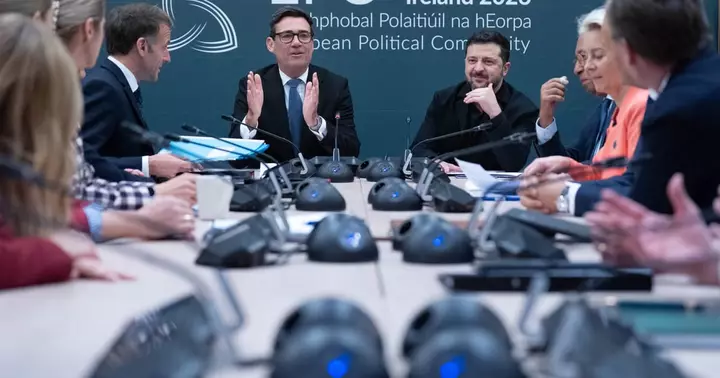
They came to discuss AI, but EU leaders spent most of their time during a summit in Dublin on Friday grappling with questions about Ukraine — namely who should represent them in future peace talks. Despite plenty of disagreement about whether it should be a single person (and if so, who) or a collection of them, they managed to strike a deal: Future talks would involve national security officials from Germany, France, the U.K., Italy and Poland — the so-called E5 powers — plus representatives from the European Commission and European Council. A classic European compromise.
Ireland, which holds the EU’s rotating presidency and hosted the informal gathering, had billed the meeting as a rare chance for a high-level discussion on how to develop artificial intelligence in accordance with European values. But the question of how to secure peace in Ukraine — and who should negotiate on Europe’s behalf — quickly dominated discussions, as leaders sparred over the format of future peace negotiations and warned about the risks of a potential deal brokered between Trump and Russian President Vladimir Putin. Indeed, a meeting next week between the U.S. and Russian leaders has set Europe on edge, prompting warnings about a possible Yalta-type agreement in which superpowers would decide on European security questions over the heads of countries directly concerned, reminiscent of talks toward the end of World War II that divided Europe up between the four allied powers.
And let’s work together for genuine peace in Ukraine.” The question of who should represent Europe in future discussions about Ukraine and the post-conflict security order was added to the summit’s agenda at the last minute, following a request from Italian Prime Minister Giorgia Meloni. Earlier in the day, Merz had voiced preference for a narrower group made up of officials from Berlin, Paris and London, while Kaja Kallas, the EU’s chief diplomat, argued that she was best placed to lead discussions. No, we don’t,” said Kallas.
Over a lunch of baked salmon fillets and crushed Ballymackenny potatoes, EU leaders grappled with the question of how to make AI more “sovereign” — that is, less dependent on U.S. and Chinese technology providers. Amid a global outage of Microsoft software (since resolved), Mistral CEO Arthur Mensch urged leaders to direct some €260 billion currently spent on foreign technology toward home-grown tech infrastructure, research and development. While the bloc has solid foundations on which to build AI solutions, Europe needs “speed, financing and a strong coordination between member states,” said Mensch.
But the AI discussion quickly ceded ground to existential questions about Ukraine, including how the bloc would finance Kyiv in coming months and whether Europe would get a seat at the table in upcoming rounds of Ukraine-Russia talks brokered by the U.S. Just as leaders including Ukraine’s president were gathering in Dublin, Russian President Vladimir Putin said he was open to Europeans joining the talks, reversing Moscow’s previous opposition. Kremlin spokesperson Dmitry Peskov quickly followed up with qualifications, however, stating that Europeans must first demonstrate “genuine intention and readiness to contribute to the peace process” before being admitted — a condition that Kallas quickly dismissed as a “trap.” “If we start to talk about what Russia is asking regarding the security architecture, we actually walk into the traps that Russia is setting us, which is that we divert attention away from that there is no ceasefire,” she told reporters in Dublin.
Other officials said that Russia’s preconditions for allowing Europe to join the talks would mean concessions to Moscow’s war demands, namely a withdrawal of NATO from European states bordering Russia, the lifting of sanctions and a ban on foreign troops in Ukraine. Giorgio Leali, Pieter Haeck, Sebastian Starcevic, Caroline Hug and Shawn Pogatchnik contributed to this article from Dublin.
Extract — continue reading at the source.