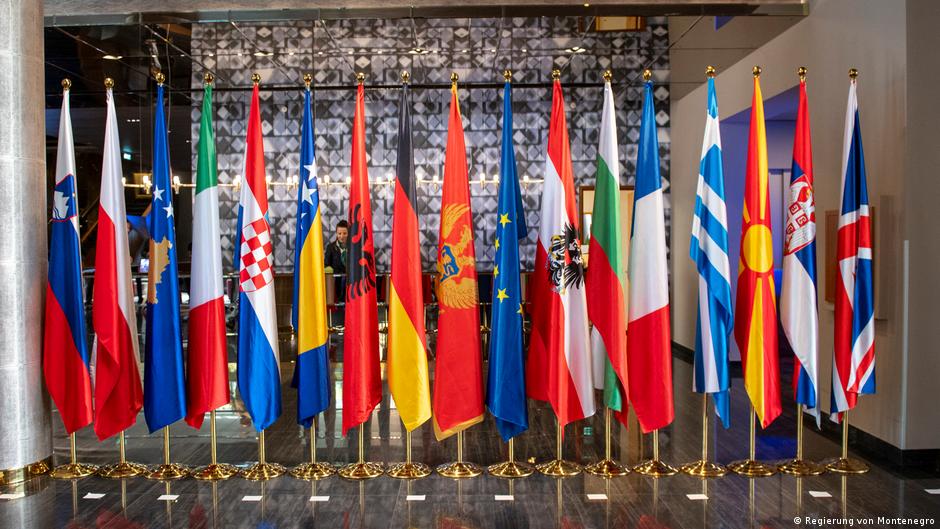
The European Commission on Tuesday published a document called "Preparing for a wider Union," which sought to lay out new proposals on "the policy orientations and actions needed to prepare the [European] Union for future enlargements." Commission President Ursula von der Leyen said that "Europe's future depends on the choices we make today," as she tries to encourage progress at the EU's leaders' summit this month and in other upcoming talks on the matter. The EU's executive proposed an array of changes — including a gradual integration process for would-be members, new safeguards "to ensure that commitments undertaken during accession negotiations continue to be fulfiled steadily after accession," and changes to voting rules. They were trying to strike a balance between simplifying the accession process, incentivizing candidate countries to continue to pursue it, and allaying concerns among existing members about potential risks or costs of expansion.
In the quarter century after the end of the Cold War, the EU rapidly grew from a union of 12 member states to 28, before dipping back down to 27 when the UK left following 2016's Brexit referendum. But the process has ground to a halt ever since, with a series of candidate countries stuck in lengthy negotiations and little apparent appetite among members to continue to expand. In recent years, amid Russia's invasion of Ukraine and signs of the US vying for increased influence in parts of Europe, theoretical interest in expansion has picked up once more.
But realizing the idea, with strict rules governing the accession process and the need for unanimous support among existing members for many core steps, has remained challenging. To view this video please enable JavaScript, and consider upgrading to a web browser that supports HTML5 video Von der Leyen said the Commission was trying to prepare institutions, adapt policies and adjust budgets to reflect shared realities to better facilitate and accommodate expansion. "Enlargement of our Union is a geopolitical imperative," she said.
"Today, we are laying the groundwork to ensure that a larger Union is also a stronger one: more resilient, more effective, and firmly anchored in the values and rules that define us." She said that as countries progress on their path towards reform, "the EU must be ready to welcome them." Enlargement Commissioner Marta Kos said that Brussels' assessment "shows that the EU can accommodate a larger membership." But "there are areas where we see challenges we need to address," she acknowledged. "One is the rule of law and sincere cooperation, where we are proposing stronger possibilities to prevent backsliding, including reducing funding or restricting voting rights," Kos said. The Commission lays out a number of proposed changes or policies designed to smooth the accession process, including but not limited to: All these proposals will be subject to further discussion among European leaders and governments, with the next major meeting being next week's EU leaders' summit.
Should they gain traction and progress, no doubt after some alterations and amendments along the way, they would ultimately have to face and pass various voting procedures to be implemented. A total of eight countries currently have formal candidate status, meaning they are seeking to join the EU and have at least begun the often lengthy process that involves. Some hope to join the bloc sooner rather than later, not least frontrunner Montenegro, after years of negotiations.
Kos told DW last week that Montenegro was currently on track to become the next EU member by 2028. Others, like Turkey, have nominally been candidates for decades but have made no discernible progress for years. Ukraine is the newest addition to the list, having only gained full candidate status in 2024, but it is also the one with the most pressing motivation to hurry the process along amid Russia's invasion.
Extract — continue reading at the source.