Europe’s political leaders have become increasingly accustomed to explaining why things cannot be done. There is always another crisis, another budget constraint, another geopolitical emergency or another promise that difficult decisions will eventually produce better results. But across France and Germany, a younger generation is beginning to ask a more uncomfortable question: when exactly will those results become visible?
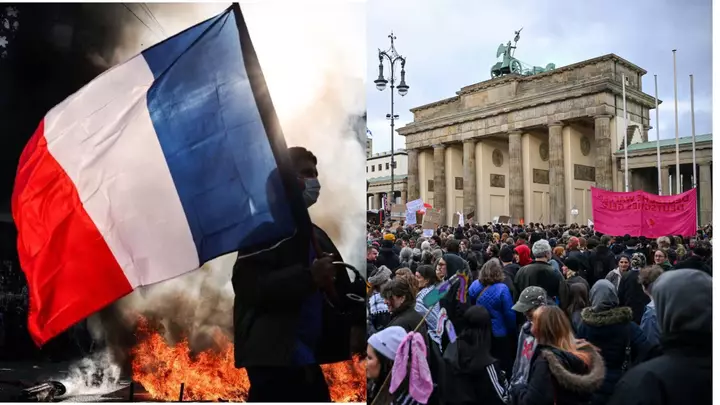
The streets of Europe offered a striking answer on Saturday, 31 October, as demonstrations spread across France and Germany for a third consecutive weekend in France and on a nationwide scale in Germany. What began as student anger over deteriorating schools, inadequate public services and the rising cost of living has evolved into something considerably broader. Trade unions, climate activists, public sector workers and supporters of the Yellow Vest movement have joined the demonstrations, turning local grievances into a wider challenge to political authority.
France remains the most visible expression of this discontent. According to the Interior Ministry, approximately 320,000 people took part in Saturday’s demonstrations, including 70,000 in Paris. Organisers put the national figure closer to half a million.
Although participation has declined from the 550,000 recorded on 17 October and 410,000 on 24 October, the scale of mobilisation after three consecutive weekends suggests that the underlying anger is far from exhausted. The most revealing aspect of the French demonstrations is their composition. Schoolchildren and university students are no longer protesting in isolation.
Trade unionists, public sector employees, ordinary workers and Yellow Vest supporters have found common ground in their frustration with a system they believe is failing to provide basic opportunities and security. The original demands concerning poorly maintained school buildings, teacher shortages and an increasingly criticised university admissions system have expanded to encompass wages, living standards, social inequality and the future of public services. For Emmanuel Macron, this represents another serious indictment of a presidency that promised to modernise France but has struggled to reconcile economic reform with the everyday expectations of ordinary citizens.
Nearly a decade after entering the Élysée Palace, Macron faces a country in which political authority increasingly appears disconnected from social reality. His difficulties are not simply the result of an unpopular policy or an isolated economic downturn. They reflect a deeper failure to convince large sections of the population that the state understands their concerns, let alone has the capacity to address them.
Extract — continue reading at the source.