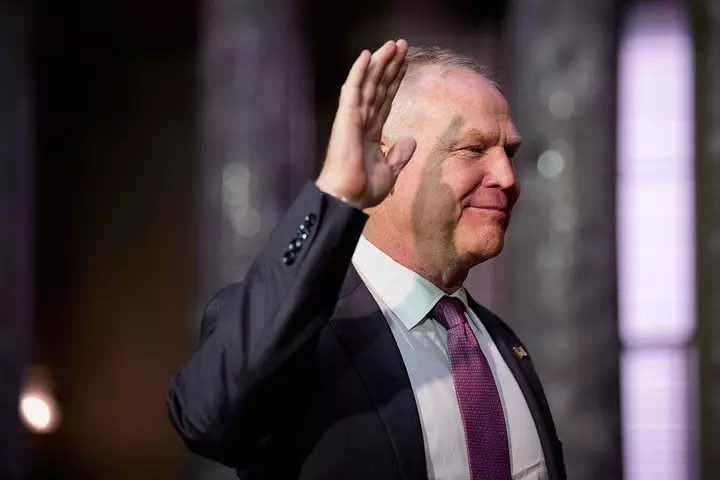
Oklahoma Republican Senator Alan Armstrong is pushing Congress to overhaul federal permitting rules, arguing in a Newsweek interview that the country needs new power infrastructure to accommodate data centers and other growing electricity demand without passing costs on to households. His argument comes as artificial intelligence infrastructure becomes an increasingly potent affordability issue: 71 percent of Americans oppose building an AI data center in their local area, according to Gallup, while researchers debate whether the rapid buildout is already driving up household electricity prices. Armstrong, appointed to the Senate this year and unable to run for a full term under Oklahoma law, told Newsweek that data centers have become a convenient target for frustration over utility bills.
He instead blamed inadequate generation and grid infrastructure and said his permitting proposal would require large new users to shoulder the additional costs they impose on the system. Public resistance to data centers is substantial and crosses party lines. Gallup's March 2-18 survey found that 71 percent of U.S. adults opposed building an AI data center in their local area, including 48 percent who strongly opposed it.
Only 7 percent strongly favored it. Opposition was higher than the 53 percent who opposed building a nuclear power plant in their area in the same survey. The poll of 1,000 adults had a sampling error margin of plus or minus 4 percentage points.
The reasons extend far beyond generalized discomfort with AI. In a separate April Gallup survey, half of data-center opponents raised concerns about resource use, including 18 percent who specifically cited water and another 18 percent who mentioned energy. Roughly one in five opponents pointed to potential economic consequences, including higher utility bills and cost-of-living increases.
Gallup found majorities across major political groups opposed local construction. Armstrong rejected the idea that the solution is restricting the industry's growth. Armstrong's contention that data centers are being unfairly blamed for higher electricity bills touches on a rapidly developing economic debate.
Few dispute the scale of the new demand. An August 2026 analysis by Lawrence Berkeley National Laboratory and the Brattle Group said U.S. data-center electricity demand more than doubled from 2018 to 2024 and could roughly triple again from 2024 through 2028. The researchers warned that serving very large customers creates financial and operational risks for utilities, including insufficient power supply and investments that could go unused, with consequences that could reach other customers.
Extract — continue reading at the source.