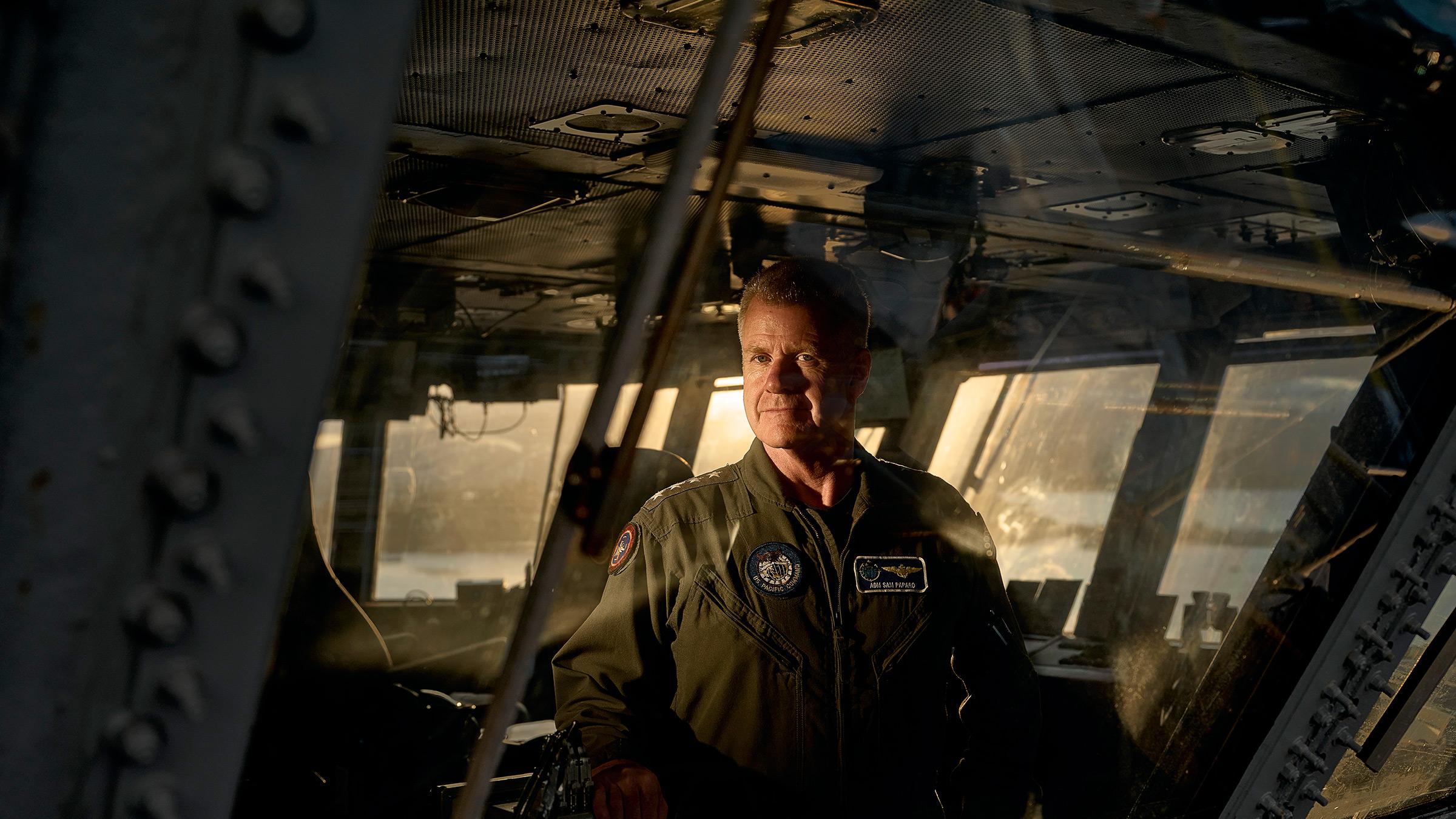
In the summer of 1986, when he was a college student in Pennsylvania, Samuel Paparo took his future wife Maureen to watch Top Gun. Many young Americans emerged from theaters across the country with a new hero: the brash, daring, risk-taking Maverick, played by Tom Cruise, who became an avatar of American power at the twilight of the Cold War. But Paparo took away a different lesson.
He’s the hard-working guy that does the right thing, that doesn’t do flashy, dangerous stuff for its own sake.” Paparo had already passed the Navy’s entrance exams when he went into the theater that day, and joined the next year. His career would precisely mirror the fictional Iceman’s: He attended the Navy Fighter Weapons School, also known as TOPGUN; became a fighter pilot; then a four-star admiral; and eventually commanded the Pacific Fleet. But Paparo would go further, taking the helm of the U.S.
Pacific Command, the nation’s oldest and largest geographic combatant command, which covers about half of the earth’s surface. Few Americans will have heard of Admiral Paparo, and that suits him fine. Pacific Command in Hawaii, on a hill overlooking Pearl Harbor, in late July.
But his role places him at an inflection point, as American dominance in the Pacific faces its most serious challenge since World War II. His command is designed to be the immovable object that blocks the unstoppable force of China’s expansionist ambitions in the region. And those ambitions have been stated clearly: Beijing has vowed to bring Taiwan, the self-ruling island that has been politically separate from the mainland since China’s civil war ended in 1949, under its control—by force if necessary.
China’s President Xi Jinping has described unification as “a historical inevitability.” Paparo’s job, in its simplest terms, is the projection of American power. His most important mission is to deter a Chinese invasion of Taiwan, an event that would challenge the very foundations of a global system underpinned by American hegemony. That the outlines of this mission stay the same regardless of which party or President is in the White House speaks to the importance of his role.
The force Paparo builds and the plans he puts in place last for decades, and could determine to whom the next century belongs. The public face of American military power is, of course, the Commander in Chief. The public voice emanates from the Oval Office and the podium in the White House press briefing room.
Extract — continue reading at the source.