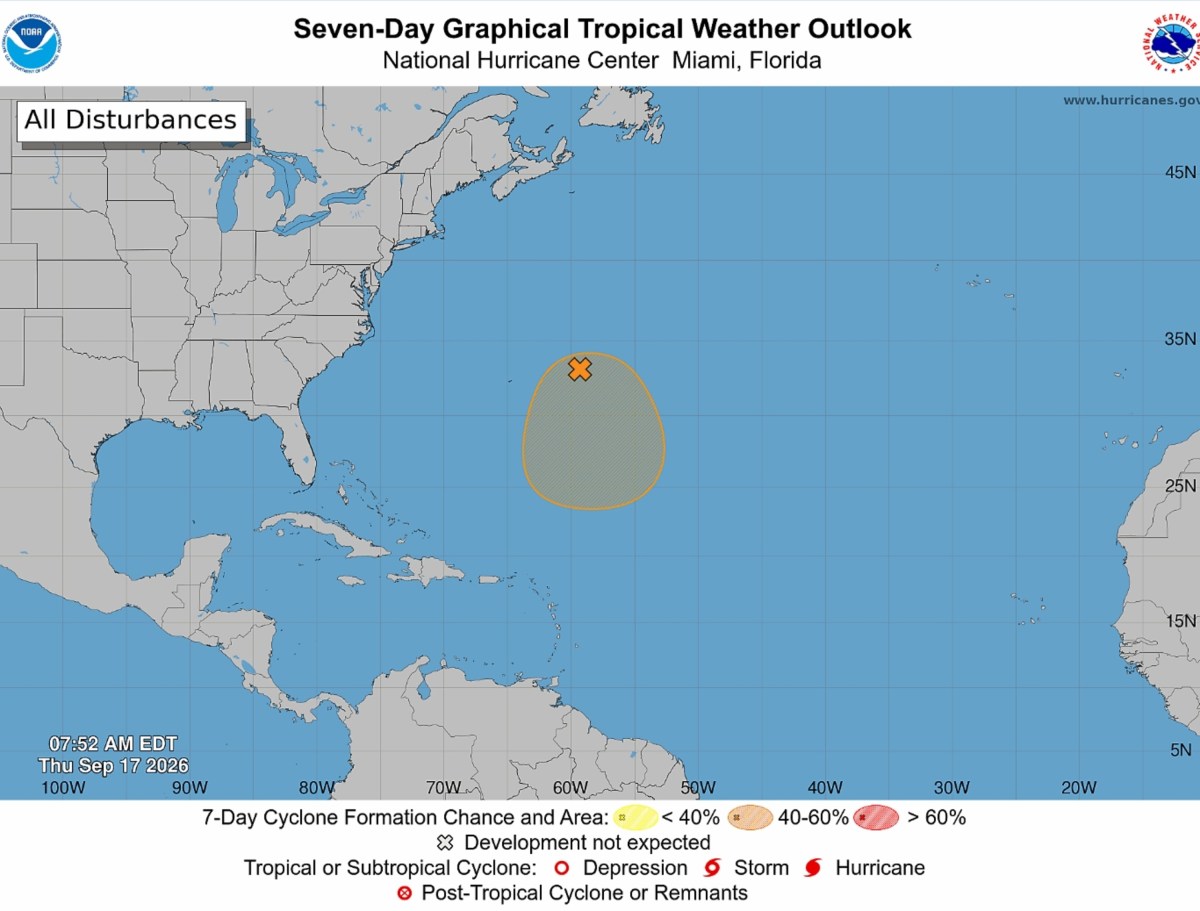
Weather experts are warning that the first hurricane of the Atlantic season could form near Bermuda later this week after the developing El Niño climate pattern has contributed to a below-average year so far. The development comes as the 2026 Atlantic season has set the record for being the longest a season has gone without a hurricane forming since 1966 when satellite technology became available. Before this year, the latest occurrence of the season's first hurricane was September 11 in 2002 and 2013.
The Atlantic hurricane season runs from June 1 to November 30. Typically, the season's most active time falls in September, but so far this year there have been no hurricanes. Part of that is due to increased wind shear across the Atlantic basin, which can be influenced by El Niño and can destroy a storm system before it has a chance to form.
El Niño is the warm phase of the El Niño-Southern Oscillation cycle that causes above-average sea temperatures and weakened trade winds in the tropical Pacific. While the pattern can lead to increased hurricane formation in the Pacific basin, it can decrease tropical activity in the Atlantic basin. Forecasts anticipate that El Niño will continue strengthening through the end of the year, with a greater than 90 percent chance it will become "very strong" in the fall and winter months.
However, the quiet Atlantic hurricane season could be coming to an end as meteorologists track a developing disturbance around 350 miles east of Bermuda. The National Hurricane Center (NHC) said there is a 40 percent chance that tropical formation will occur within the next 48 hours. Chances that it will form within the next seven days are also at 40 percent.
Although the storm's organization hasn't changed recently, the NHC said, gradual development of the system is expected to occur over the next few days. "The system is forecast to move slowly today, and then possibly turn southward on Friday over the subtropical Atlantic," the most recent NHC forecast said. "By Sunday, environmental conditions are forecast to become less favorable for development." DaSilva said people in Bermuda should continue to monitor the storm's development, but the impact to the U.S. was expected to be low.
Several meteorological agencies have been referring to the ongoing El Niño as a "super" event. Although the National Oceanic and Atmospheric Administration (NOAA) refers to the climate pattern as "very strong," both labels refer to an event in which waters are warmer than average, usually around 2 degrees Celsius above average. The warmer the waters, the greater the influence on weather.
Extract — continue reading at the source.