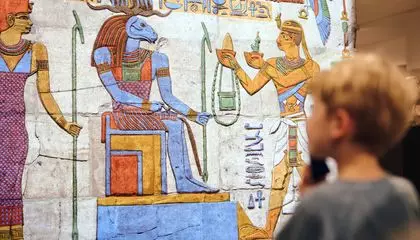
Roughly 2,700 years ago, in the deserts of present-day northern Sudan, a massive shrine was brought to rise in the city of Kawa. Built from 236 sandstone blocks inside a temple to Amun-Ra, the king of the ancient Egyptian gods, the shrine’s ornate sandstone walls told an unmistakable story of devotion and power. Known as the Shrine of Taharqa after the pharaoh who commissioned it, the structure’s carvings show several depictions of Taharqa—the ruler of both Egypt and Kush between 690 B.C.E. and 664 B.C.E.—extending offerings to gods while exerting royal influence among his mortal subjects.
Modern research suggests that during Taharqa’s time, these scenes were plastered and painted in vibrant color. But by the 1930s, when the shrine was excavated by British archaeologists, the carved sandstone was remarkably intact but colorless. Subsequently transferred to the Ashmolean Museum in Oxford, England, modern eyes have only ever looked upon the shrine—the only free-standing pharaonic building in Britain—as a beige sandstone relic.
Later this month, however, the museum will restore the lavish shrine as Taharqa once saw it, with the help of digital light projections. Among the most notable of their discoveries was evidence of Egyptian Blue, the world’s oldest-known synthetic pigment, typically reserved to color depictions of high-profile royals and deities. Researchers also identified traces of yellows and reds, among other vibrant hues.
The earliest known sample of Egyptian blue is on an alabaster bowl painted in 3250 B.C.E. Starting on November 13, visitors to the Ashmolean will see these and other colors projected onto the walls of the shrine, bringing life to the stories told on the ancient walls. According to McNamara, the carvings partially tell the story of the shrine’s creation, starting with a young Taharqa visiting the semi-buried ruins of an earlier temple to Amun-Ra, built under the reign of Tutankhamen, and vowing to restore the shrine, the Art Newspaper’s Maev Kennedy reports.
It also shows Taharqa depicted as both an Egyptian pharaoh wearing the double crown representing Upper and Lower Egypt, as well as a Kushite king with a ram’s head and cobras. The projection will be accompanied by two newly produced films, which share further details about the 43-square-foot shrine and its 2,500-mile journey from Sudan to England in the 1930s. According to museum records, the shrine was given to Oxford by the Sudanese government in recognition of Egyptologist Francis Llewellyn Griffith’s contribution to the region’s archaeology.
Griffith and his team encountered swarming midges as they disassembled the shrine and put it into 200 wooden crates, each wrapped in palm fibers and loaded onto a barge. It sailed up the Nile River and was carried by train to the Red Sea. Another vessel made the final leg to England.
Extract — continue reading at the source.