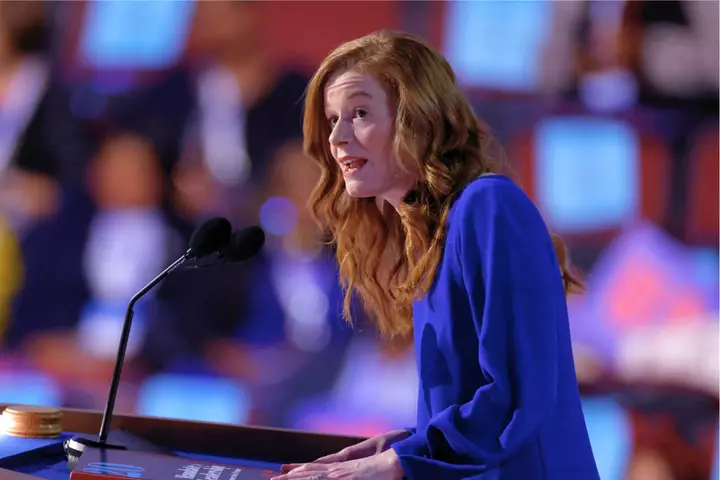
Former Michigan Democratic Senate candidate Mallory McMorrow says a fabricated poll “killed” her campaign after portraying her as a distant third in the primary and the weakest of the three leading Democrats against Republican Mike Rogers. McMorrow—a state senator—entered the Democratic primary for the open U.S. Senate seat being vacated by Gary Peters, making her one of the initially significant contenders alongside Abdul El-Sayed and U.S.
Representative Haley Stevens. The Wedgewood Polls survey, released June 29 and later acknowledged by the organization as fabricated, put McMorrow at just 9 percent in the Democratic primary, compared with 46 percent for El-Sayed and 39 percent for Stevens. It also showed her losing to Rogers by 7 points in a hypothetical general-election matchup, while El-Sayed led Rogers and Stevens was tied with him.
McMorrow suspended her Senate campaign on July 5, less than a week after the poll was released, and about a month before the August 4 primary, though her name remained on the ballot. El-Sayed subsequently won the Democratic nomination, and McMorrow endorsed him and called for Democrats to unite behind him. But now, in a series of posts on X, McMorrow blamed Wedgewood’s late-June Michigan poll for her campaign’s downfall, saying “That killed us.” Newsweek reached out to McMorrow via email for comment.
Wedgewood Polls claimed it had surveyed 602 likely general-election voters from June 25 to 28, including an oversample of 353 likely Democratic primary voters. In addition to giving McMorrow a single-figure chance in the primary, the purported poll showed Rogers beating McMorrow 48 percent to 41 percent in a hypothetical general-election matchup, while Stevens tied Rogers at 46 percent and El-Sayed led Rogers 49 percent to 44 percent. The claimed margin of error for the primary sample was ±5.7 percentage points.
But on October 20, Wedgewood Polls acknowledged that the vast majority of the polling it had released was not supported by genuine survey data. The organization described itself as an "experimental project" intended to demonstrate weaknesses in the polling industry. The admission came after FiftyPlusOne researchers Mary Radcliffe, G.
Elliott Morris and Cooper Burton investigated a later Wedgewood Polls survey. They found irregularities in supposedly raw Pollfish data, including respondent and transaction IDs that didn't behave as genuine data from the platform should. When confronted with the findings, Wedgewood later acknowledged that it had fabricated the vast majority of its polling releases.
Extract — continue reading at the source.