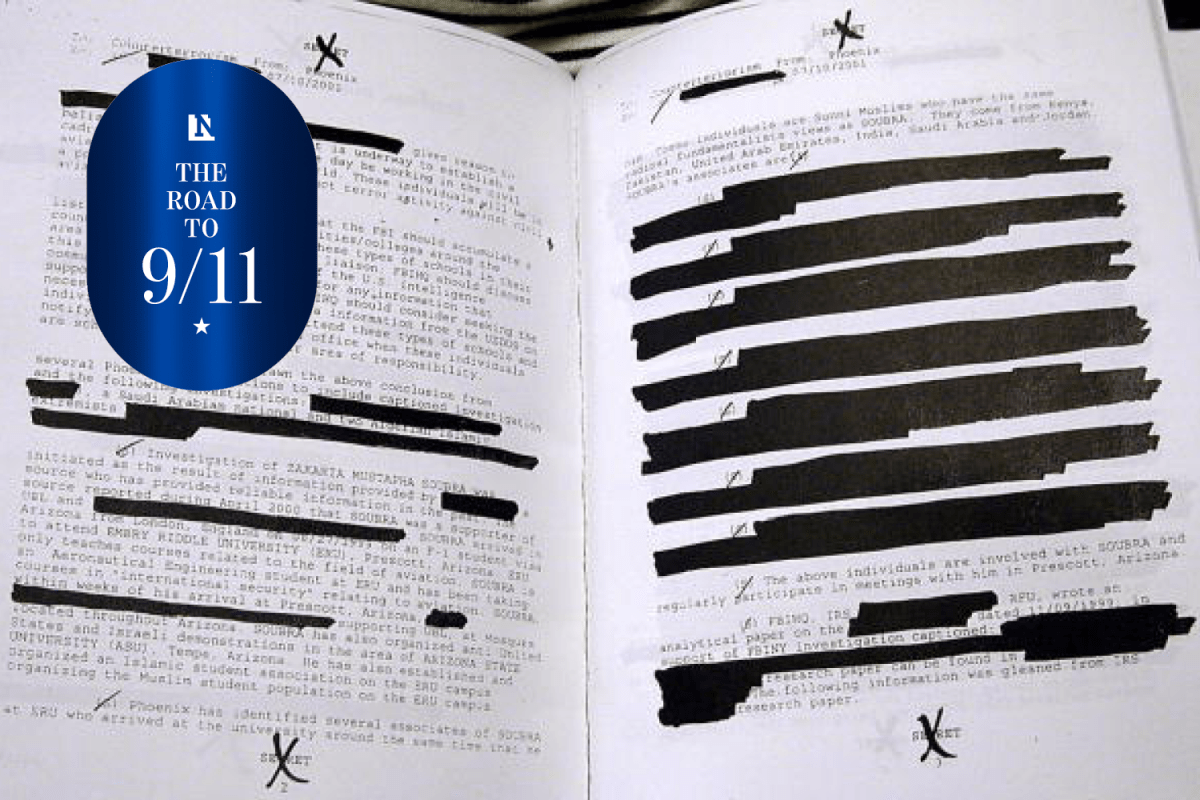
For the 25th anniversary of the September 11th attacks, Newsweek is republishing a day-by-day reconstruction of the events that led to the worst terrorist attack on American soil. If you'd like to receive each day's entry by email, become a Newsweek Member today. Yesterday: Even al-Qaeda leaders didn't know the date of the planned attack.
When told, they had objections—but bin Laden overruled them. August 30, 2001: CIA director George Tenet received on August 30 his second briefing about now-detained Zacarias Moussaoui, who refused to have his belongings searched and was no longer speaking with the FBI. Tenet was told that French intelligence has connected Moussaoui to extremist behavior in that he has tried to recruit operatives for Chechnya.
In a 26-page report issued earlier from the Minneapolis FBI Special Agent working the Moussaoui case, the conclusion stated that there were "numerous inconsistencies" in his story, that he had taken a two-month-long trip to Pakistan which ended less than three weeks before he came to the U.S., and that he could not explain the source of $32,000 in his checking account. All of this, the agent wrote in the report, "give cause to believe he is conspiring to commit a terrorist act, especially when this information is combined with his extremist views ... in his sworn statement." But after much revision inside the FBI as to whether to pursue a FISA warrant, many of the Minneapolis conclusions were changed or softened at headquarters: The Minneapolis agents later told the Department of Justice Inspector General that headquarters' changes appeared to be "dumbing [their report] down" and that the edits "would definitely cause [the FISA request] to fail." Marion "Spike" Bowman, the head of the FBI National Security Law Unit, later told the IG that he did not believe, based upon the facts, that there was sufficient evidence of a link to a foreign power. FBI Headquarters began taking steps to finalize Moussaoui's deportation.
That day, in addition, more information came in from Paris confirming Moussaoui's identity as the same as the man with connections to Chechen extremists. This was necessary as FBI headquarters was questioning whether the Moussaoui in custody was the same person. The Minneapolis field office later told the Department of Justice Inspector General that this request was "another arbitrary roadblock" being erected to bolster the denial of seeking a FISA warrant.
The French source additionally stated that Moussaoui was a radical fundamentalist who was "very dangerous" and that he was "extremely cynical" and "a cold stubborn man, capable of nurturing a plan over several months, or even years and of committing himself to this task in all elements of his life." He had traveled to Kuwait, Turkey, and Afghanistan. Also on August 30, according to Tenet, a CIA liaison officer at the FBI contacted a fellow CIA officer on assignment and wrote, "Please excuse my obvious frustration in this case. I am highly concerned that this is not paid the amount of attention it deserves.
I do not want to be responsible when they surface again as members [sic] of a suicide terrorist op ... I want an answer from a named FBI group chief for the record on these questions ... several of which I have been asking since a week and a half ago. It is critical that a paper trail be established and clear.
Extract — continue reading at the source.