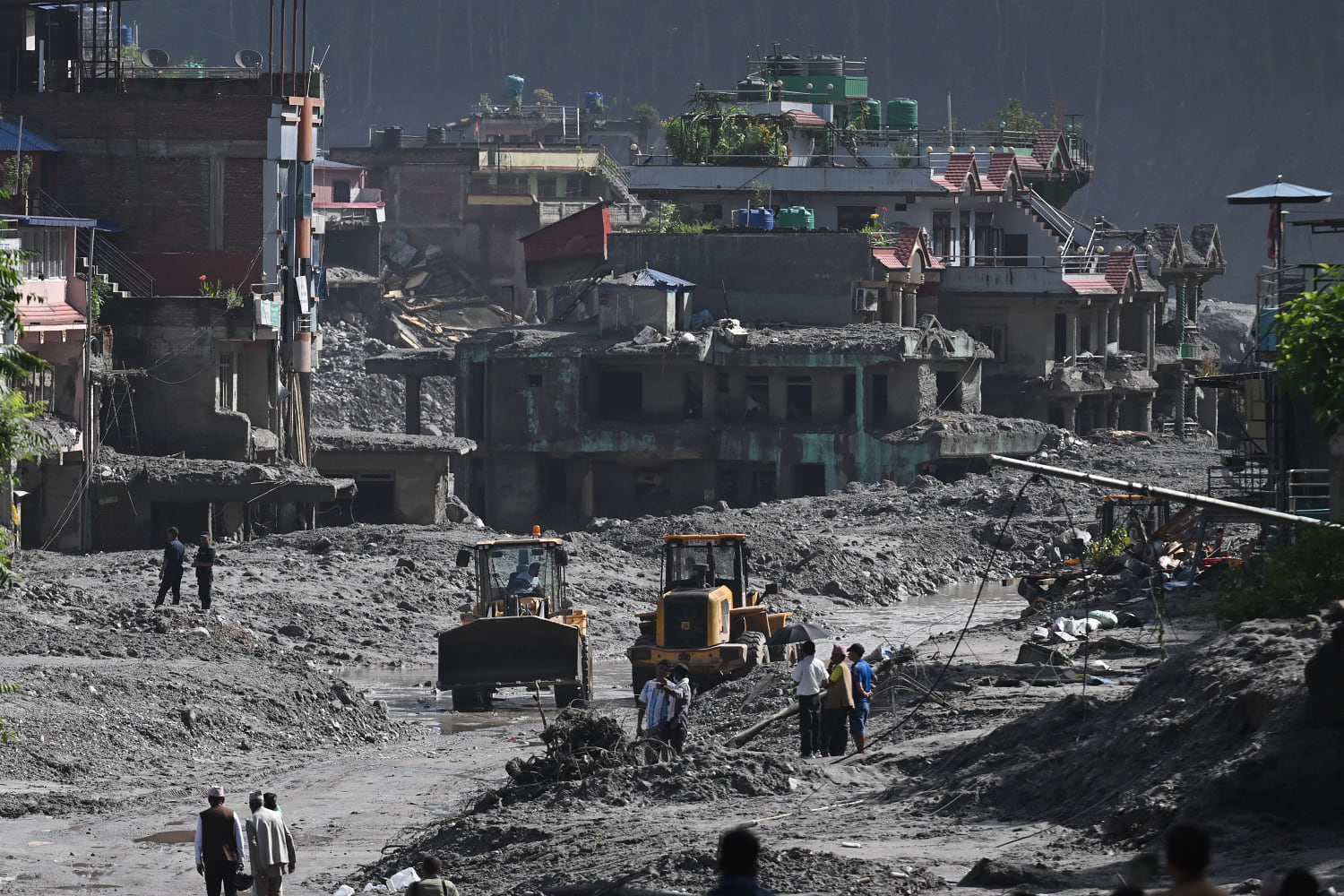
KATHMANDU — Authorities in Nepal have warned of the risk of further flooding after heavy rainfall, as China sheds light on the scale of the disaster in its Tibet region. Five days after surging floodwaters from a glacier collapse buried communities across the region in thick mud, rescuers in Nepal were still struggling to reach devastated communities as the full scale of the destruction emerged. We’re going in as fast as we can to get people the help that they need.” Cole said his team would be working to provide help to those in need a locate missing persons, but that working in mud “is actually pretty dangerous.” “The longer that death and mud are together, diseases breed, and so we’re always just aware of that,” he added.
Approximately 100 Americans are among the missing across Nepal and China’s Tibet region, the State Department said Saturday. How did the catastrophic Nepal-Tibet flood happen? In Nepal, the death toll has risen to 752, with over 2,500 people still missing, including 592 foreign nationals, according to the country’s disaster agency.
The Nepal Tourism Board said 261 foreign nationals have been rescued. China has separately reported 16 deaths and 546 people missing in its Tibet region, including 261 foreign nationals. It is unclear how much overlap there is between the Chinese and Nepali missing-person counts.
Those missing loved ones may face a long wait for answers, with many bodies washed far downstream and recovered in poor condition. Morgues in Nepal have been overwhelmed, though authorities are collecting DNA samples in the hopes of notifying relatives. In Nepal’s Chitwan district, where a number of bodies have washed up, police officer Anil Thapa told that “more than half” of recovered bodies were “beyond recognition.” “Many have no visible faces.
In some cases, only hands or legs remain,” the officer added. The response is also being complicated by a landslide-dammed lake above the border checkpoint that is overflowing, while heavy rain in Nepal has pushed up river levels and prompted fresh warnings for people living along waterways. Nepal’s Flood Alert system said Sunday that heavy rainfall had been measured in various watershed areas of Gandaki Province, and that the water levels were “expected to rise.” “Therefore, people living in riverside areas are requested to adopt caution,” it said on X.
But in flood-hit areas, residents were struggling to make sense of repeated warnings since the initial floods. There is also rain,” Govind Shreshta, a resident of the town of Galchhi, told . I have a 72-year-old father and 70-year-old mom.
Extract — continue reading at the source.