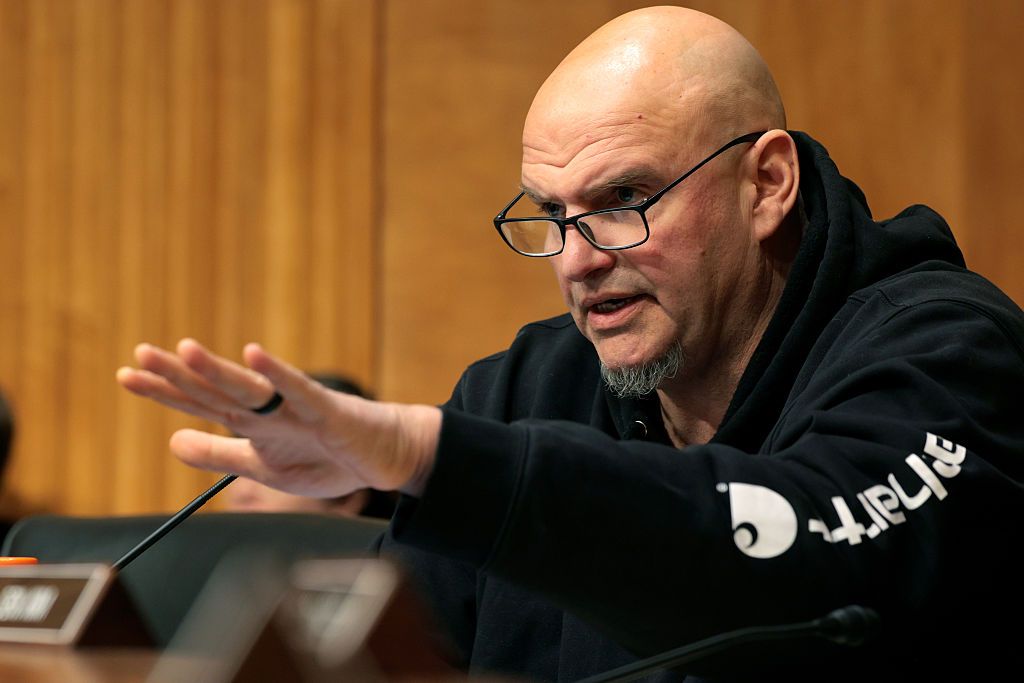
Senator John Fetterman's voting alignment with fellow Democrats has declined, and he votes less with his own party than any other member of the Senate, analyses show. That voting record is now at the center of a broader backlash against the Pennsylvania senator, one that intensified this month after a Wall Street Journal investigation alleged he had skipped Senate hearings, dismissed constituents and clashed with his own staff — fallout that has included calls from fellow Democrats for him to step down and renewed talk that he could leave the party altogether. Fetterman has pushed back on the WSJ report's allegations and stood by his record.
Separately, he has repeatedly swatted back rumors that he may become a Republican. Here is what his voting record shows, what has been alleged, how Fetterman has responded, what's behind the party-switch speculation and how voters in Pennsylvania and nationally are reacting. Newsweek reached out to Fetterman's office on Monday morning to request additional comment.
By the most widely used measure of party loyalty — CQ/Roll Call's annual vote studies, which track how often senators side with their party on "party unity votes" where a majority of Democrats oppose a majority of Republicans — Fetterman broke from the Democratic position on roughly 20 percent of those votes in 2025. That made him the least party-loyal Democrat in the Senate, effectively inheriting the title once held by former West Virginia Senator Joe Manchin, who left the party in 2024. Senate Democrats as a whole averaged 92 percent unity in 2025, the same analysis found.
The comparison holds against Republicans, too. Senate Republicans averaged 96 percent unity in 2025, and their least-loyal member, Alaska's Lisa Murkowski, broke from the GOP just 13.4 percent of the time — well below Fetterman's roughly 20 percent defection rate. By that measure, no senator of either party voted against their own party more often than Fetterman did in 2025.
Fetterman has pushed back on the "defector" label, saying he votes "a 91 percent Democratic line" when all his votes, including routine and procedural ones, are counted. The shift is a break from his own past, however. CQ/Roll Call's 2024 vote study didn't flag Fetterman as an outlier at all; that year's least-unified Democrats were Montana's Jon Tester, who lost reelection, at 96.5 percent, and Manchin, already gone from the party, at 82.8 percent.
An independent tracker of his full Senate voting history, Fettermanvoting.com, puts his cumulative record since taking office in January 2023 at about 88 percent with Democrats — several points higher than his 2025 rate alone. That gap indicates the break from the party is concentrated in his third year in office and continuing into 2026, rather than a pattern that has defined his time in the Senate overall. Notably, Fetterman was the only Senate Democrat to vote to confirm Pam Bondi as attorney general, and he also backed Kristi Noem for Homeland Security secretary, while opposing Robert F.
Extract — continue reading at the source.