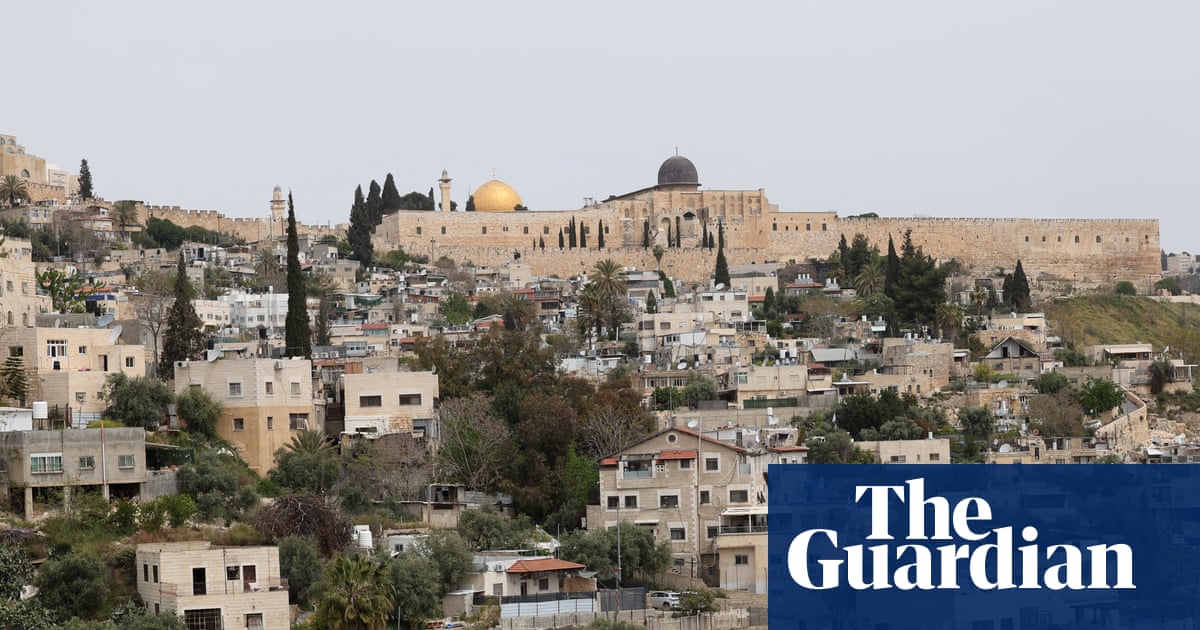
A fifth foreign company has pulled out of a plan to build a cable car from West to East Jerusalem that threatens to involve the seizure of land and property rights from dozens of Palestinian families along its route, but local authorities insist the scheme is proceeding as planned. The project appeared to have stalled for four years until late September, just weeks before Israel’s 27 October elections, when the Jerusalem Development Authority (JDA) issued a notice of intent to award a contract without a public tender to ROPES, a cable car engineering consultancy based in South Tyrol, Italy. However, Stephan Obexer, chief executive of ROPES told the Guardian his company had declined the consultancy work because of another commitment in India.
The 1.4km cable car route, approved by the Israeli government in 2019 and upheld by the high court in 2022, would connect West Jerusalem to a planned 16,000 sq metres tourist complex promoted by Elad, a settler organisation seeking to consolidate Israeli control over Palestinian areas of occupied East Jerusalem. The Israeli occupation of the Palestinian territories began in 1967 and the Old City and the rest of the eastern half of Jerusalem were fully annexed in 1980, although they are still considered occupied under international law. According to Emek Shaveh, an Israeli NGO, the JDA had recently accelerated plans for a long-delayed cable car through occupied East Jerusalem, where Israel’s continued presence has been ruled unlawful by the international court of justice, in a project once described by former Jerusalem mayor Nir Barkat as a way for visitors to “understand who is truly the landlord of the city”.
At least four foreign companies – three French and one Swiss – have expressed interest in the project, but several have withdrawn over its political sensitivity, according to Haaretz, an Israeli newspaper. In 2015, the French government urged one company not to participate. Another French company, CNA, pulled out less than a year ago, followed more recently by Switzerland’s Histec Engineering.
ROPES did not respond to a request for a written statement or questions about whether legal concerns over the project’s location in occupied East Jerusalem had influenced its decision. The JDA did not respond to the Guardian’s request for comment. But a spokesperson for the JDA told Haaretz: “Following the high court of justice’s dismissal of petitions against the project about a year and a half ago, the cable car continues to proceed according to plan and in accordance with the timetables set.
Steps to promote the project are subject to the mandatory tenders law, and the tender is expected to be ready for publication in the coming months once its formulation is completed.” The move has sparked protests from Israeli heritage and environmental groups and Palestinians in Silwan, an East Jerusalem neighbourhood at the foot of the Old City, who warn that the project threatens Palestinian heritage in territory they seek for a future state and would see cable cars passing just metres above their homes. Elad is notorious for using state resources to advance its political agenda in East Jerusalem, taking over Palestinian properties, evicting families and settling Jewish residents in their place.” The Elad Foundation, which does not appear to be formally involved in the project, did not respond to the Guardian’s request for comment. According to rights groups, the cable car project directly threatens about 54 Palestinian homes along its route in the Wadi Hilweh neighbourhood in Silwan, with the expropriation of either land or air rights, and indirectly threatens many others in the vicinity.
Israeli authorities have issued 17 expropriation notices covering about 8.7 dunams (2.15 acres) of land along the proposed route, where pylons supporting the cable car would be erected. Expropriations of land and homes for support pillars have already been set in motion, leaving residents in a constant state of uncertainty.” Reached by the Guardian, the Israel Nature and Parks Authority said: “Our involvement was limited to providing feedback on the proposed alternatives.” Across occupied East Jerusalem, Israeli settlers are increasingly taking over Palestinian properties, while authorities have stepped up demolitions of homes lacking building permits, displacing families. The Mount of Olives, home to some of Christianity’s holiest sites, has also become a target of
Extract — continue reading at the source.