French photographer Jean-Pierre Laffont spent two decades capturing demos, clashes and countercultural gatherings in America. All photographs by Jean-Pierre Laffont/Courtesy of Damiani Books_ Black Panthers Protesting at Yale University, New Haven, Connecticut, 2 May 1970 In 1964, French photographer Laffont arrived in the US as an immigrant with a camera, allowing him to phoograph the counterculture up close. From here he would dedicate his life to documenting America from the 1960s to the 1980s.
His iconic pictures offer an outsider’s perspective on a generation defined by its drive to question established norms Protest of Kent State Shootings in Washington DC, 9 May 1970 Laffont: ‘I went to Washington DC, where students from all over the US gathered for a demonstration in response to the Kent State killings five days earlier. It was a massive anti-war protest. I took this photo as the student protestors all jumped into the reflecting pools – many removed their clothes, and it became a joyful demonstration’ Crucified Protester at Washington DC Demonstration, 9 May 1970 ‘I took this photograph in front of the White House, where one student protestor strapped himself to a crucifix.
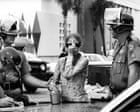
As they mourned the students killed at Kent, this symbolic act represented the sacrifice and suffering of his generation, dying both at home and abroad for a war they objected to’ Abbie Hoffman and Jane Fonda at Protest, Washington DC, 9 May 1970 Political activists Abbie Hoffman and Jane Fonda attend a protest against the spread of the Vietnam war to Cambodia 30th Republican Convention in Miami, Florida, 23 August 1972 Outside the 1972 Republican convention, police arrest 1,000 demonstrators attempting to disrupt the event. Several thousand Women’s Lib protesters, led by Jane Fonda, were joined by Vietnam veterans to speak out against the war. As Lafonte recalls: ‘I was in Miami to cover the Republican national convention, where Nixon was campaigning for re-election.
Anti-Vietnam war protestors flocked to the city, and there were many arrests and violent clashes between protestors and police all over the city’ ‘I photographed the arrests of defiant Women’s Liberation activists as they descended on the city opposing Nixon’s re-election campaign’ ‘I spent three days at the Summer Jam at Watkins Glen, which at the time was the largest rock festival in US history. I took this picture from the top of my little Renault 5. I was using a Leica tele-lens to photograph the crowds as they arrived by the thousands.
A split second before the moment passed, I caught this couple sharing a quiet kiss. This iconic photograph appeared on the back cover of Life magazine – and to this day I still don’t know who they are’ ‘I took this photograph at the funeral procession in Bedford-Stuyvesant for six of the prisoners slain in the Attica state prison uprising. Mourners took over the streets, raising their fists – the Black Panthers’ symbol of solidarity’ ‘I photographed Betty Friedan, president of the National Organization for Women, leading the Women’s Strike for Equality on 6th Avenue and Central Park South.
It was the 50th anniversary of the 19th amendment, which gave American women the right to vote’ Street Gang ‘Savage Skulls’, South Bronx, New York City, 20 July 1972 ‘In the summer of 1972, I spent time with the Savage Skulls, a Puerto Rican street gang based around Fox Street in the South Bronx. They were a fearsome gang, but they were very friendly with me – they sensed that I was an outsider too, which made them comfortable with me. They climbed up this fence so that they could all fit in a photograph together, striking a pose reminiscent of West Side Story.’ _Read more in our My Best Shot feature_ ‘I took this photograph at Rajneeshpuram, a utopian community founded by followers of the spiritual teacher Bhagwan Rajneesh.
Extract — continue reading at the source.