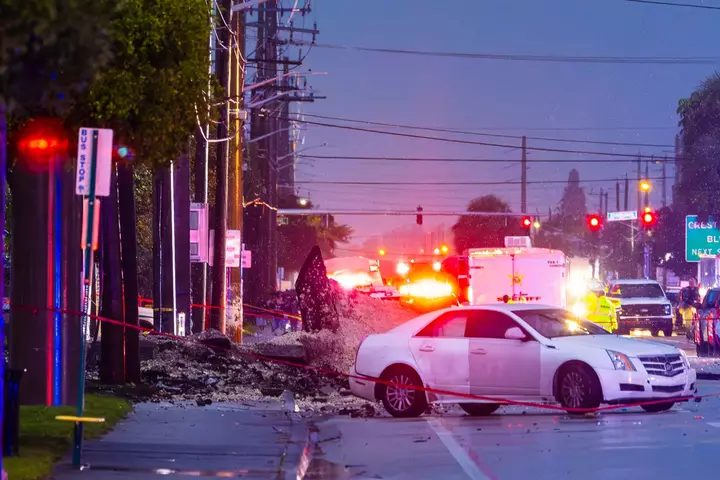
Nine people on board a Learjet 60 aircraft were killed on Sunday when the plane crashed in Palm Beach County, about nine miles from President Donald Trump’s Mar-a-Lago estate. The co-pilot of the flight has since been identified by family members as Nathalia Gadelha Filgueiras. The 20-year-old grew up in Palm Beach County and has been flying since she was 17.
The captain of the flight has been named as 55-year-old Jeffrey Gregory. Following Filgueiras’s identification, several social media commentators posted attacks on female pilots, prompting criticism from aviation experts. Becky Lutte, an associate professor and chair in the Department of Aeronautics at the Embry-Riddle Aeronautical University, who is on the leadership team of ERAU Boeing Center for Aviation and Aerospace Safety, told Newsweek: "If you are in the seat, you earned the seat.
All pilots must earn the appropriate certificates and ratings for the operation." Looking at the dynamics in the cockpit, Lutte said: "The Pilot in Command has final authority over aircraft operation, but each pilot on the flight deck has an active role in safety." "Pilots often alternate between the pilot flying and pilot monitoring roles," Lutte added. "The pilot monitoring typically handles ATC communications, monitors the flight path, altitude, airspeed, aircraft configuration and automation, performs checklists and additional duties." She pointed to the NTSB investigation into all relevant aspects of the flight and emphasized that the public should respect this process. "For the victims and their families and friends, be respectful of all who perished.
This is a heartbreaking event for the entire aviation community," added Lutte. The gender or race of pilots has been a focal point in discourse in the wake of several past aviation accidents. In 2025, just days after the start of President Donald Trump’s second term, American Airlines Flight 5342 collided with a UH-60 Black Hawk helicopter over the Potomac River in Washington, D.C.
All 67 aboard both aircraft were killed in what marked the deadliest U.S. air disaster since the crash of American Airlines Flight 587 in 2001. In the wake of the air disaster, conversations quickly focused on diversity, equity and inclusion (DEI) initiatives within the Federal Aviation Administration and the Department of Transportation. The president said after the crash that he had "very strong opinions" on why the crash occurred, and pointed to DEI policies while discussing the helicopter and traffic control, in remarks that came shortly after his administration ordered a rollback of a number of DEI policies.
The NTSB identified operational and systemic failures involving the FAA and U.S. Army; it did not identify DEI practices as a cause. A similar thread played out on social media after the Learjet crash this past weekend.
Extract — continue reading at the source.