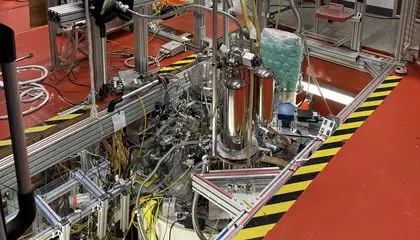
How do you contain a fast-moving particle that disappears as soon as it touches almost anything? You build a very special trap. For the first time, researchers have used electric and magnetic fields to capture and maintain an elusive kind of particle known as a positron—the antimatter cousin of an electron.
In a study published October 21 in Physical Review Letters, the team describes how they have kept the particle trapped for months, where they can control and study it. The work paves the way for a test that could make or break a longstanding theory of particle physics. The work is a “remarkable achievement,” Barbara Latacz, a particle physicist at CERN who did not participate in the study, tells Nature’s Elizabeth Gibney.
Many people are familiar with electrons, protons and neutrons—three kinds of particles that make up atoms—but the universe also hosts particles known as antimatter, essentially the opposite of “regular” matter. Every kind of “regular” particle has a twin-like particle of antimatter with an equal mass but the opposite electrical charge. Positrons are the antimatter versions of electrons, antiprotons are the antimatter versions of protons and antineutrons are the antimatter versions of neutrons, for example.
When antimatter meets its equivalent matter, the particles annihilate, or essentially disappear, converting their mass into energy. Annihilation presents an interesting conundrum regarding the birth of the universe. Scientists would have expected the Big Bang to produce the same amount of matter and antimatter.
But this scenario would have also caused the entire universe to disappear. That clearly isn’t the case, and today the known universe has significantly more matter than antimatter. The standard model of particle physics—which explains the interactions between the building blocks of matter and fundamental forces in the universe—doesn’t have an explanation for why this is our reality.
Even though this theory has proven to be extraordinarily accurate overall, it still has glaring issues—and it can’t predict why the universe exists. So something must be missing. Our universe has more matter than antimatter—in fact, antimatter is very hard to find.
Extract — continue reading at the source.