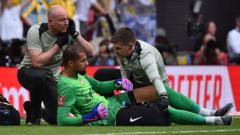
Four ways to tackle football's frustrating 'tactical timeout' . Tactical stoppages need clamping down on - Murphy Chelsea goalkeeper Robert Sanchez slowly sat down on the Wembley turf and signalled that he needed treatment during Sunday's FA Cup semi-final against Leeds United.Referee Jarred Gillett blew his whistle, and waved the physio on to the pitch.All Chelsea's outfield players jogged over to the technical area to get instructions. Coaches use it as a way to regroup, or simply to stifle the opposition.
Loud boos rang out from the Leeds fans inside the stadium, all too aware of this frustrating tactic.Leeds captain Ethan Ampadu was so annoyed that he tried to place himself inside the Chelsea team talk.Officials have been powerless to prevent the stoppages happening.The International Football Association Board (Ifab) has been looking at the problem, but no law change has been agreed in time for next season.Instead, leagues will be offered the chance to carry out a series of trials.Here is what is being proposed.What is the goalkeeper tactical timeout?Until a couple of seasons ago, it was usually an outfield player who would go to ground to stop play.It was being used for two distinct reasons.Either to break up the momentum of the opposition by causing a stoppage in play, or for the coach to give instructions to his players. Sometimes it has been both. English football attempted to combat this by insisting that any player who receives treatment must leave the field for 30 seconds.It had some positive results, but managers just switched focus and told the goalkeeper to ask for treatment.
A team cannot play without a goalkeeper, so it became a risk-free method of impacting the opposition, or getting the opportunity to talk to your team. There is nothing a referee can do about it, as they cannot accuse a player of faking an injury. If it turned out the player was genuinely injured there could be serious repercussions.
So the game has been stuck in a doom loop. Goalkeepers go down, the other 10 players rush to the technical area for a team talk. As soon as the coach has delivered his message, the keeper miraculously gets to his feet.
It has been a theme during Leeds' season, starting in November when Manchester City goalkeeper Gianluigi Donnarumma went down as the West Yorkshire club were in the ascendancy at Etihad Stadium. Manager Daniel Farke accused Donnarumma of feigning injury to "bend the rules" and break up play.But this is not a Leeds issue, it is a football issue. It is happening at all levels of the game and is particularly prevalent in the women's game.What are Ifab doing about it? oing down claiming they have been injured has become common in football at all levelsThere is an argument that Ifab has been far too slow in tackling this.The issue has been discussed for a couple of years and was the subject of lengthy debates in the technical meetings of the football and referee advisory boards in October.Ifab changed several laws for next season to cover delaying tactics - including putting a time limit on goal-kicks, throw-ins and substitutions.
But there was no agreement over the best course of action to end the goalkeeper tactical timeout.The result? Leagues will be invited to hold trials throughout the 2026-27 season.The Women's Super League (WSL) has put its hand up to be part of the testing process.Ifab will look at the results in March next year, and at that point one solution might be chosen to go into the laws in every league.Trial one: Take an outfield player off for one minuteWhile English football, and a few other leagues, had unilaterally brought in the 30-second rule, Ifab has gone a step further.From next season, the laws will stipulate that any player who needs treatment must go off for one minute. The first potential goalkeeper tactical timeout trial would simply follow that logic.If a goalkeeper needs treatment, then another player on the team must leave the field for a minute.There could be parallel trials to determine who should go off - either the captain or a player selected by the manager.
Extract — continue reading at the source.