sözaltı news World
World
EN AZ
Fragile quiet in Lebanon as US-Iran truce leaves unanswered questions

Fragile quiet in Lebanon as US-Iran truce leaves unanswered questions

bbc.com 16.06.2026 20:20 16 baxış
Many Lebanese remain doubtful that the agreement could finally mean the end of the fighting between Israel and Hezbollah.

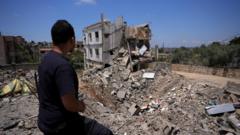
Fragile quiet in Lebanon as US-Iran truce leaves unanswered questions Hugo BachegaMiddle East correspondent, BeirutReutersAn estimated 50,000 homes have been damaged or destroyed in Lebanon during the warOn Monday, hours after the announcement of a ceasefire agreement between the US and Iran, families that had been displaced because of the war began to return to communities in southern Lebanon, despite warnings from the authorities that it was not safe yet. In a video widely shared online, some residents arrived by car in a village to find an Israeli armoured vehicle blocking a street.Exhausted after more than three months of conflict, the people of Lebanon hoped the truce would also stop the fighting here between Israel and the Iranian-backed armed group Hezbollah. A fragile quiet appears to be holding, despite Israel and Hezbollah carrying out attacks over the past day, but many remain doubtful that this could finally mean the end of the war.A man called Abo Ali, who had been displaced from Jebchit in the Nabatieh area of southern Lebanon said his family "had returned, but with caution".

Surrounded by heavily damaged buildings, he said: "All of this can be compensated for, and rebuilt."Another man, Moustafa, was returning to the village of Aadshit, near Marjayoun, carrying only a suitcase. "For someone who's used to this area and has lived here, to come back and see this destruction is extremely hard," he said. But he too remained unsure if the lull in the conflict would hold.

"Israel can't be trusted," he added.ReutersOne million people remain displaced across Lebanon, most of them Shia MuslimsThe US-Iran agreement has not yet been made public, and it is unclear how it will apply to Lebanon. Both Iran and Pakistan, which acted as a mediator, said it included a ceasefire in the country - an Iranian demand that had become a key obstacle in the negotiations.This round of conflict between Israel and Hezbollah started in March when Hezbollah launched rockets into Israel in retaliation for the killing of the Iranian supreme leader, Ayatollah Ali Khamenei, at the start of the US-Israel war against Iran. Israel responded with a devastating bombing campaign across Lebanon and another invasion of the country's south.For Iran, including Lebanon in the truce was crucial in strengthening its image among Hezbollah supporters, who have been deeply affected by the conflict, and in reinforcing Tehran's influence domestically.

Iran has financed, trained and armed Hezbollah since its creation in the 1980s.Despite being weakened in the recent wars with Israel, the group, which is also a political party and a social movement running services including schools and hospitals, remains a significant force among Lebanon's Shia Muslim community. Last month, I visited communities in the south of the country, Hezbollah's heartland, and saw that support for it endured amid Israel's constant attacks.Israel had argued that the conflict against Hezbollah was separate from the one in Iran and that it should continue. But under pressure from the US, it may be left with no option other than to wind down, if not stop, its military campaign.This war has been catastrophic for Lebanon.

More than 3,800 people have been killed, including many women and children, according to the country's health ministry, whose figures do not distinguish combatants from civilians. The Israeli military says it has killed more than 2,500 Hezbollah operatives; and Israeli authorities say 30 Israeli soldiers and four civilians have been killed during the war on both sides of the border.One million people remain displaced across Lebanon, most of them Shia Muslims. Even with a ceasefire, many will not be able to return home.EPAIsrael's government says Israeli forces will remain indefinitely in occupied parts of southern LebanonAnd the truce still leaves unanswered questions.Around 5% of Lebanon's territory is under Israeli occupation, and there is no indication of a withdrawal.

Dozens of villages have been destroyed, and it is not clear when reconstruction will start, and who is going to pay for it. Israeli authorities say the aim is to create what they describe as a security zone along the border, Hezbollah-free, to protect communities in northern Israel from the group's rockets and drones. After the US-Iran truce was announced, Israeli Defence Minister Israel Katz said Israel would stay indefinitely in land seized in Lebanon.Finally, there is the issue of Hezbollah's arsenal.

Extract — continue reading at the source.

Read full story