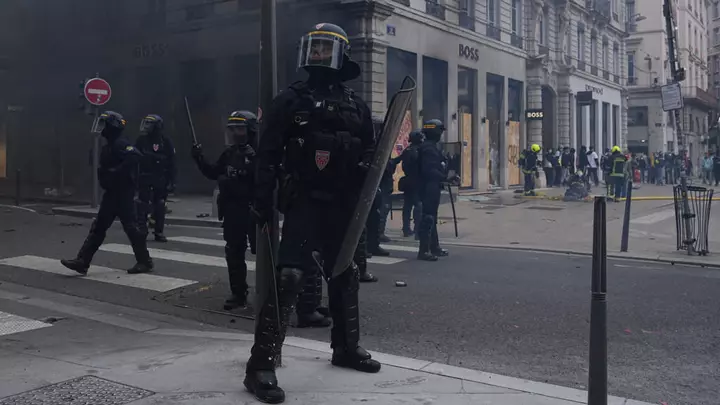
Demonstrators marched across France on Saturday in massive protestsdrawing about 550,000 people, according to authorities while organisers put the turnout at 800,000. Following scenes of violence involving the police and certain demonstrators as well as looting, arson and at least 2,400 arrests, France is facing a debate over its _maintien de l'ordre_(“public order”) police doctrine. To display this content from YouTube, you must enable advertisement tracking and audience measurement.
One of your browser extensions seems to be blocking the video player from loading. To watch this content, you may need to disable it on this site. Sparked in high schools inFrance’s overseas territories andtaken up by schools in under-served Parisian suburbs, student blockades quickly spread across the country in recent weeks, with students demanding more resources for education and complaining aboutdilapidated infrastructure and a lack of teachers.
The movement morphed this weekend into national demonstrations with unions, student organisations and activists hoping to revitalize the Yellow Vests movement, which emerged in November 2018 in protest of fuel prices and the high cost of living. Read more'Finish what we started': After student protests, France braces for return of the Yellow Vests Protests turned into scenes of turmoil and clashes with the police with many demonstrators reporting being sprayed with tear gas and police using “intermediary force” weapons which are used in crowd control by French law enforcement and havebecome a focal point of debate in recent weeks following several high school students being woundedin protests. On Saturday, in Saint-Étienne in southeastern France, a 17-year-oldlost his hand to a grenade while in Mulhouse, in the northeast, a young woman of the same agelost use of hereye.One protester died on the fringes of a demonstration in Paris following a “probable cardiac arrest” but local authorities said they did not yet know the circumstances surrounding his death.
Read moreSevere injuries at French student protests draw scrutiny to police tactics Prisca Ancion, a lawyer who works in the Paris suburb of Seine-Saint-Denis and a member of Collectif d'Action Judiciaire – a collective of lawyers founded and run by members of hard-left party Révolution Permanente – has closely followed the high school student protest movement. She said the weekend’s protests showed how heavily armed the French police have become. Cover image: France: Police and protesters clash violently over the weekend © France 24 Ancion said special police units such as the CRS (the branch in charge of crowd and riot control) and the BAC (the anti-crime brigade) carry equipment classified as A2 – military-grade weapons –under France’s internal security code, including stun grenades, crowd dispersal grenades, rubber bullet launchers (also known as “flashballs” or “LBDs”) and tear gas labelled as “non-lethal”.
Oliver Davis, a professor and head of the Department of French at University College Cork, said terms like “non-lethal” are “euphemisms”, and that these weapons, which entered French public order policing in the 1990s, can be extremely dangerous. According to him, these units tend to be far more militarised and confrontational than riot police in most other European countries. He added that Greece is one of few EU countries with a comparable approach in which de-escalation is not the guiding principle.
Macron's 'sense of detachment' amid rising living costs and youth 'fears for future' To display this content from YouTube, you must enable advertisement tracking and audience measurement. According to Olivier Cahn, a specialist of criminal law at the University Paris-Nanterre, there was a shift in national policy for crowd control in 2016 during the Nuit Debout (Up All Night) protest movement against proposed labour reforms, which came a year after the Charlie Hebdo terror attacks. That shift was further formalised in 2025 with a "National Urban Violence Scheme” which led to an overall harsher policing doctrine.
Extract — continue reading at the source.