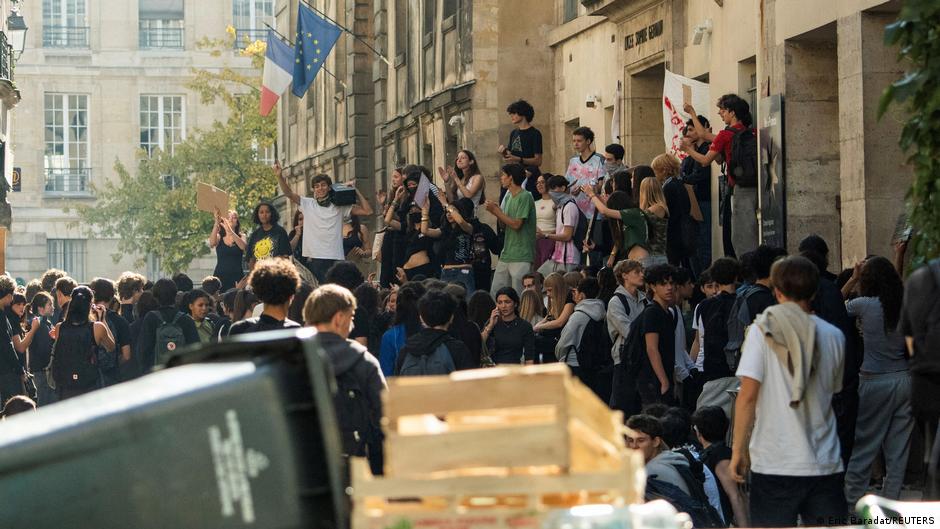
France’s Prime Minister Sebastien Lecornu is unlikely to have had a quiet weekend. For almost two weeks, students across France have been protesting, angered by class cancellations, overcrowded classrooms and run-down school buildings. The protests have increasingly been overshadowed by serious clashes with police.
At the same time, the government accuses the left-wing party La France Insoumise (LFI) of exploiting the protests for political purposes and fueling the blockades. On Friday, Education Minister Edouard Geffray tried to ease tensions by meeting with student representatives. Instead, a nationwide day of protest took place on Tuesday.
On Sunday evening, the prime minister took charge of the crisis. In a letter to several ministers, Lecornu called for concrete proposals: Class cancellations should be addressed more quickly, school buildings should be upgraded to cope with hotter summers, and the controversial university admissions system "Parcoursup" should become more transparent. Initial decisions, along with funding and a timetable, are expected to be announced this month.
But Macron's ally Lecornu faces one key problem: He has to promise young people more government support while his government is imposing an austerity budget on the entire country. Last Thursday, the government submitted its 2027 budget proposal to parliament. The budget deficit is expected to fall from a projected 5.4 % of economic output this year to 5% in 2027.
To make up the shortfall, the government plans to make spending cuts worth billions of euros. France is already subject to an EU excessive deficit procedure and is expected to bring its budget gap back toward the 3% limit set by the European Union. To view this video please enable JavaScript, and consider upgrading to a web browser that supports HTML5 video "It is an austerity budget," says Eileen Keller of the Franco-German Institute (dfi) in Ludwigsburg.
At the same time, the draft is a signal to the financial markets. The government wants to show "that it is taking responsibility" and lay out a path toward reducing the deficit. The government plans to cut spending by the state itself, local and regional authorities, as well as in the social sector.
Extract — continue reading at the source.

