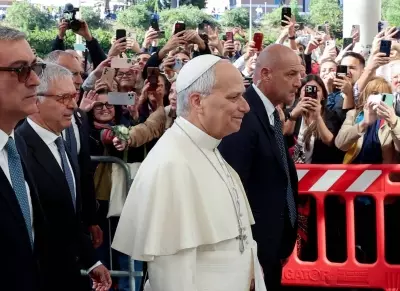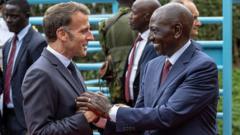
France seeks to move beyond colonial ties by meeting African leaders in Kenya Akisa Wandera,BBC Africa, NairobiandHafsa KhalilAFP via ImagesThe French president (L) is in Kenya, where he is co-hosting the Africa Forward Summit alongside his Kenyan counterpart (R)Accused of neo-colonial meddling in many African countries where it has traditionally had close ties, France is broadening its horizons by co-hosting a summit of African leaders in English-speaking Kenya for the first time.Speaking at the Africa Forward Summit in the capital Nairobi on Tuesday, French President Emmanuel Macron repeatedly spoke of "co-investment" and "equal footing partnerships" as he described shared challenges, including security, economic dependence and geopolitical competition.Kenya's President William Ruto, who is co-hosting the two-day summit, shared his sentiments, adding that Africa must help shape the emerging global order rather than remain on its margins.Macron has announced investments worth $27bn (£20bn) in Africa in areas such as energy transition, digital and AI, the maritime economy and agriculture."Africa is succeeding. It's the youngest continent in the world… and needs investment to become more self-reliant," he said on Monday, adding that this would create some 250,000 jobs in Africa, and in France.AFP via ImagesMany people came out to take photos with the French president"We are not simply here to come and invest on the African continent alongside you - we need the great African business leaders to come and invest in France," he told the audience at Nairobi's convention centre, reports the news agency.The summit is aimed at broadening Paris's partnerships and making investment deals on the continent against a backdrop of rising anti-French sentiment and diminishing power in its former colonies, especially in West Africa. This reflects a step-change in how Paris thinks of its relationships with Africa.For many years after independence in the 1960s, France maintained close economic, political and security ties in many of its former colonies, leading to widespread accusations that little had changed.And French presidents over the years have held regular summits with African leaders - either in France or French-speaking Africa - until now.Gilles Yabi, a Senegal-based political analyst focusing on relations between France and Africa, told the BBC's Newsday programme: "There's a new generation of Africans who… want to turn the page on colonialism and post-colonial influence."Kenya's Foreign Minister Musalia Mudavadi called it an "opportunity for Africa to start speaking as one"."Having this summit being held in a non-French-speaking African country on the continent, to me, is a very, very big message that we should not be looking at engagements on the basis of the official languages that are spoken in those countries," he told the BBC.AFP via ImagesMore than 30 African leaders attended the summit as well as the UN chiefHe said it was an "opportune moment" for Kenya and France to break away from the "more or less artificial" linguistic barriers stemming from countries being "branded" as Anglophone, Francophone or Lusophone, which "deters proper integration"."Kenya has been a pivotal country on matters of diplomacy and also conventions," Mudavadi added, explaining that the summit will cover peace and security, and then focus "largely on the economic partnership that can be developed between Africa and the rest of the world, including France".Last week, Foreign Affairs Principal Secretary Korir Sing'oei similarly spoke of Kenya's key diplomatic role, describing the nation as a "bridge-builder" in Africa.He told the BBC that as a former British colony, Kenya's relationship with France was different because it was not shaped by the same colonial history as West African countries.The military leaders who have seized power in Burkina Faso, Mali and Niger - all former French colonies - have expelled French troops who were helping in the fight against an Islamist insurgency in the region and instead turned towards Russia for assistance.Ahead of the summit, Macron defended France's significantly reduced military presence on the continent, saying French troops leaving "wasn't a humiliation but a logical response to a given situation"."When our presence was no longer wanted after the coups, we left," he explained.
"I'm convinced that we must let these states and their leaders, even putschists, chart their own course." None of the leaders of the three countries are attending the summit.Djibouti, at the mouth of the Red Sea, now hosts France's last remaining operational military base in Africa.The detained anti-colonial activist grabbing attention in West Africa: Who is Kemi Seba?Why France faces so much anger in West AfricaIs France to blame for coups in West Africa?Political analyst Yabi said hosting the summit in Kenya was an "illustration of changing dynamics" and the relationship between African nations and France."It's not only a reaction of France to the deteriorating relationship with some countries in West Africa," he told Newsday. "It's also a trend that has been there for some time because France realises that it has to look for new markets, dynamic markets and looking beyond traditional former colonies of West and Central Africa."While Kenya and France are both seeking economic gains from co-hosting the summit, Paris additionally strives to show its relevance on the continent at a time when other powers - such as China, Russia and Turkey - are gaining influence.Macron, speaking at the University of Nairobi on Monday, said Africa "needs investment to become more sovereign", explaining that the continent "no longer… needs or wants to hear" European leaders telling them what their countries need.At several points during the summit, Macron stressed that Africa "has its own agenda" and should no longer be viewed simply as a source of raw ma
Extract — continue reading at the source.