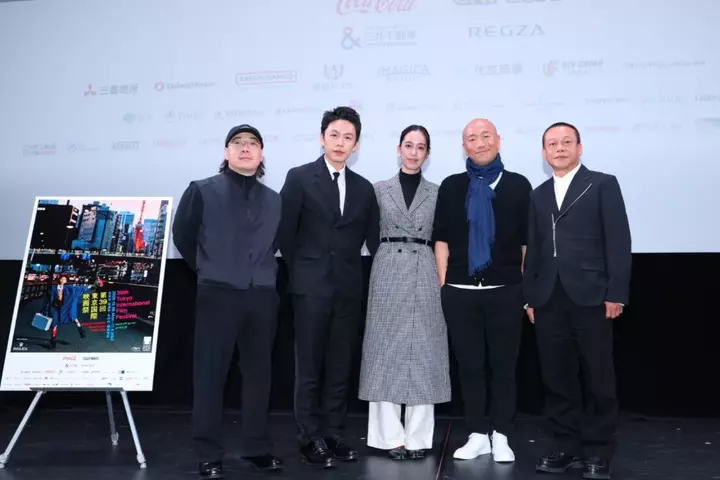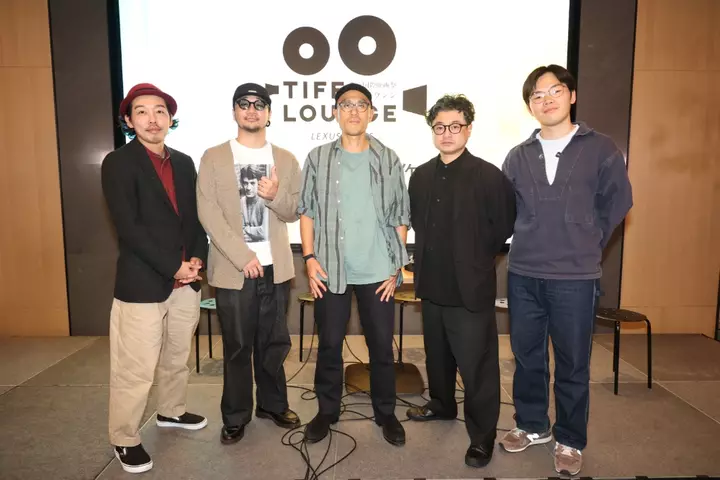
A first-time director who messaged Oscar winner Hamaguchi Ryusuke’s cinematographer directly, and a former hunter whose film led Carlos Reygadas to float a collaboration, were among five Nippon Cinema Now filmmakers who shared the unexpected connections behind their work at the 39th Tokyo International Film Festival (TIFF). The “How We Make Films” panel at Tokyo Midtown Hibiya, moderated by TIFF programming director Ichiyama Shozo, brought together Ueda Shinichiro (“Earthlings in Love”), Saito Kisin (“Kefi”), Natori Satoshi (“Chihiro | Akemi”), Matsumura Shingo (“Between Us”) and Yaza Takenoshin (“Hinotama: Ball of Fire”) to discuss the making of their radically different features. As he introduced the participants, Ichiyama noted that although the selection typically focuses on newer directors in Japanese cinema, he was interested in bringing Ueda in because of the unique vertical format of his latest film, “Earthlings in Love.” Ueda explained that the film was an adaptation of sorts, born from a 30-episode microdrama series designed for social media, hence the vertical aspect ratio.
Its budget, though, was “equivalent to a regular independent film,” he said. That already sets it apart from most microdramas, which are typically very low-budget. Ichiyama then introduced “Kefi,” a debut feature by young cinematographer Saito, which he described as “a very unique, strange film,” one where “you never know what’s happening, but at the end, it all comes together.” Asked how such a film came about, Saito said he had met a producer in charge of production and movie advertising, who found a sponsor for the project.
But as we continued our discussion, the sponsor said that we could make it as we like. So it turned out to be a very strange film,” Saito said. The original theme, he said, was “maternal love, being a mother.” The finished film instead follows three sisters after they receive the news of their father’s passing.
Moving on to “Chihiro | Akemi,” Natori spoke about a key location in the film, a house in eastern Hokkaido. I myself used to be a hunter, and with the experiences from hunting, I came up with all these ideas, and I tried to put them in this film. You go out hunting, you look for prey, and then you hunt, and then you eat the meat.
And you continue this over and over again,” Natori said. I fully felt this uncanny feeling of somebody else emerging from inside me, and I felt like this would be a really terrifying idea.” Nawata Canon, an actor and producer on the film, also incorporated her own experience of giving birth into it, Natori said. Discussing his influences, Natori cited Andrei Tarkovsky’s “Nostalghia,” calling it “foundational” because it taught him that “the plot is secondary.” To him, the texture of a film matters more, and color and style are equivalent to story.
Natori also spoke about the film’s festival run, including the Split Film Festival in Croatia, where it won the Grand Prix in the feature film competition. That led to a meeting with Mexican director Carlos Reygadas, who was on the jury. What’s going on here?’ So he personally talked to me and wanted to collaborate with me.
Extract — continue reading at the source.