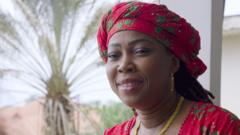
From escaping child marriage 'to an old pervert' to becoming Sierra Leone's first lady Megha Mohan, Maggie Latham and Alvaro AlvarezBBC World Service, FreetownBBCIt takes Fatima Bio only a moment to respond when we ask what it was like to be an asylum seeker in London."Better than being married to an old pervert," she says deadpan, before laughing - a reference to her father's plans to marry her off as a teenager.A lot has changed since then. In the years that followed, she became an actress, then met a man in London when she was interviewing him about influential Sierra Leoneans in the diaspora and married him. He was Julius Bio - and he is now Sierra Leone's president.As the country's first lady, Fatima Bio is seen as a compelling yet divisive figure - some young people see her as a refreshing voice in politics, who speaks up for women and girls, while others say she has overstepped her remit and that she is too vocal and too involved in the running of her husband's party.She has been booed and jeered at by MPs and criticised over a video that she shared on her social media channels featuring a notorious drugs dealer, whom she denies knowing.She quickly stops laughing and composes herself to tell us the story that inspired her to champion a law banning child marriage in Sierra Leone, which came into effect in 2024.She was almost a child bride herself.
By the time she turned 13, her father, a diamond miner from Kano district, had arranged her marriage to a man in his 30s, whom she had known as an uncle figure since she was a little girl."There was no discussion. It was decided," she says.But just before the wedding, when she turned 16 in 1996, Sierra Leone's civil war caused enough distraction to allow her to escape with the help of relatives and seek asylum in the UK.Fatima Bio landed in London on Christmas Eve at Gatwick Airport wearing a T-shirt, she says, shocked by the cold, but relieved to have the opportunity of a new life. She moved in with a distant relative."England was my amazing grace.
I went to England, I got my voice," the first lady adds. "I got my independence, and then I was able to fight for myself. And now I can fight for as many young people as possible."Something else she gained in the UK was a council flat in Southwark in central London, a home she still keeps today where her children live.
As a form of social housing, council homes are usually cheaper to rent than private accommodation and applicants have to meet certain criteria.AFP via ImagesIn 2022, Bio attended a reception at Buckingham Palace to raise awareness of violence against women, hosted by Queen Camilla, along with the Duchess of Edinburgh, Queen Mathilde of Belgium, Queen Rania of Jordan, Crown Princess Mary of Denmark, and Ukraine's First Lady Olena ZelenskaThe fact that a sitting first lady, who lives in a presidential mansion in the capital, Freetown, retains a tenancy has drawn criticism in both the British and Sierra Leonean press. With more than 18,000 people on the borough's waiting list for housing, the council's website says that "even people in the greatest need can face several years' wait".But it is a situation she defends. "My children are all British citizens," she says.
"I'm paying for my council house myself. I have not committed any crime."In a statement, Southwark council told the BBC that it does not comment on individual tenancies but "if there is doubt that tenants are meeting the obligations in their tenancy agreement, we carry out regular checks and investigations to determine that those obligations are being met" .We are at the family's farm, around an hour's drive from the Presidential Lodge in Freetown, where she usually lives with her husband. Julius Bio, a former soldier, became president in 2018 and was re-elected in 2023.
Bio keeps chicken and cattle at the family farm outside FreetownHere at the farm, the first lady seems far more at ease than at the formal functions we had previously followed her to. Wearing jeans and an Arsenal football shirt, she takes us for a walk to see her many animals, including chickens, cattle and goats.It is this accessible, aspirational image - a fresh face for Sierra Leone, where international narratives have long centred on child soldiers, British colonial rule and blood diamonds - that has won her millions of likes on social media. She posts regularly, often dancing and engaging directly with her followers.She addresses taboo topics such as period poverty.
Extract — continue reading at the source.