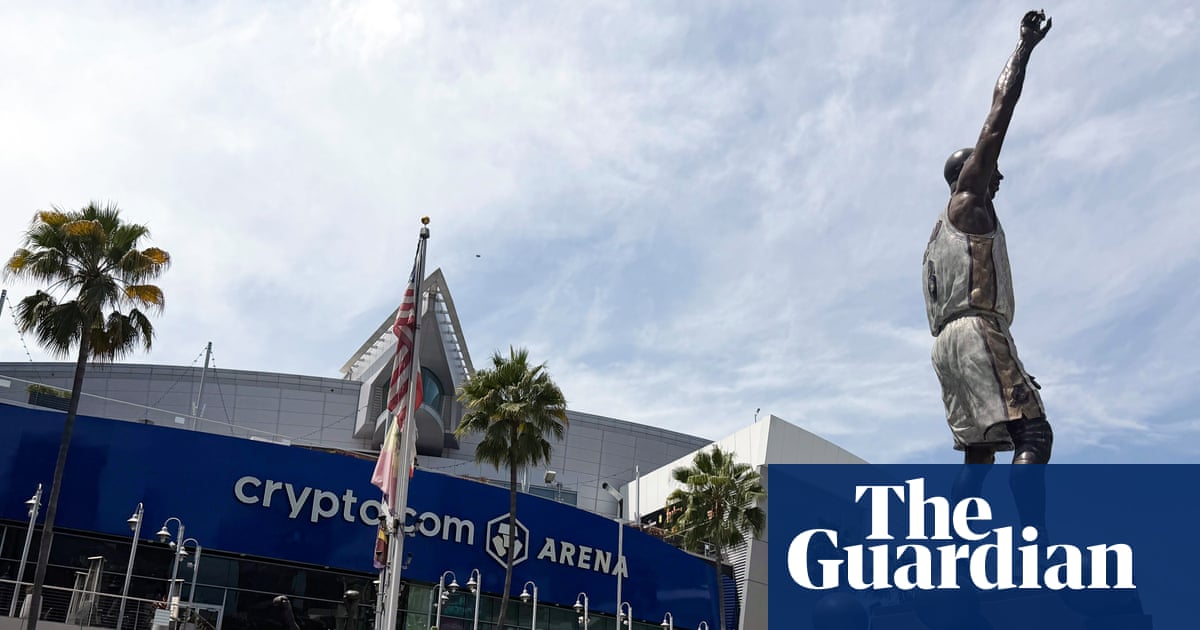
For years, the NBA was built on the alliance of patient money and marketing pizzazz, and no team captured that curious mixture better than the Los Angeles Lakers. Through Showtime in the 1980s and the dominance of the Shaq-Kobe years, the Lakers became the benchmark for a league and a sport intent on global conquest: charismatic, ambitious, and flashy, a sporting-cultural amalgam in which athleticism and celebrity held equal rank. Through careful front office recruitment, savvy coaching, and the harnessing of Hollywood’s star power, the Lakers evolved from a team into a “brand,” establishing a template that virtually every other outfit in the NBA has felt compelled to mimic in the years since.
But the razzle-dazzle on the court – the Laker Girls, Magic flinging no-look passes, Shaq smashing the glass, Jack Nicholson smiling his Joker smile in the front row, all eyebrows and mischief – depended on a far more staid and stable arrangement off it. Real estate investor Jerry Buss bought the Lakers for $16m in 1979, and remained the majority owner until his death in 2013, when his children assumed control of the franchise. When Jerry Buss died, the Lakers were valued at $1bn.
Now, the team looks set to be sold to former Disney CEO Bob Iger and venture capitalist Josh Kushner, the brother of Donald Trump’s son-in-law Jared, for $12.5bn. The sale is still under negotiation and will need to be approved by the NBA’s board of governors; the Buss siblings are also now bickering over whether to join the stampede and sell their minority 17.8% stake in the franchise to Iger and Kushner, which has added a subplot of Shakespearean family intrigue to proceedings. But in the likely event it goes through, the sale would make the Lakers the most valuable franchise in basketball.
It would also signal an acceleration in private equity’s scramble to get its claws into the world of sport. The disappearance of the patient old world of sporting capital that Jerry Buss once embodied can have no better advertisement than the fact that Iger and Kushner’s bid for the Lakers comes a little over a year after the franchise was sold to an entirely different set of private equity investors. Mark Walter and Todd Boehly announced their purchase of a majority stake in the Lakers at a valuation of $10bn in June 2025, with the Busses retaining a minority share in their family inheritance.
Walter’s mooted disposal of this sporting crown jewel – for a tidy $2.5bn bump in the franchise valuation, of course – just 14 months after he took control of it symbolizes the arrival of a brash new era in US sporting investment. Today teams are flipped with the calculated emotionlessness that a real estate speculator might get rid of a block of cheaply renovated apartments, and the old ideas of heritage, tradition, family, and community that once bound the pro leagues’ owner dynasties to their teams are now mostly useful as a rhetorical device, rather than a set of values to respect in practice. There are still teams in the NBA holding out against the tide of private money: the Indiana Pacers have been in the same (majority) hands since 1983, the Chicago Bulls since 1985.
But many long-time owners are now spying the exit, which is understandable given the boom in franchise valuations: Mark Cuban, for example, sold his majority stake in the Dallas Mavericks in late 2023 after 24 years running the franchise. He now says he regrets the sale, but only, it seems, because the team has fared so poorly since his exit and he’s no longer as influential in basketball decisions; patient money may be draining away from the NBA, but the egos attached to it remain as large and self-adoring as ever. The NBA opened up to institutional money – investment from private equity firms, hedge funds, venture capital funds, and the like – in 2022, the first big pro league in US sports to embrace the worldwide emergence of sport as an investible asset class like technology or construction.
Extract — continue reading at the source.