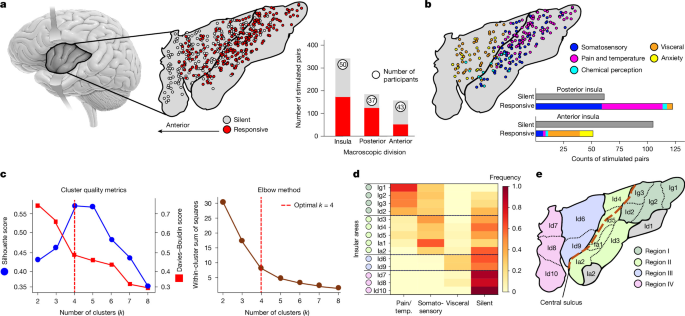
The insular cortex has a central role in pain1,2, interoception3,4 and feelings5,6, yet its functional architecture and causal electrophysiological relationships among its subregions remain poorly understood. Here we combine intracranial electrical stimulation and task-based electroencephalography recordings with connectivity mapping within a cytoarchitectonic atlas of the human insula7,8,9,10 in 87 participants implanted with intracranial electrodes, and identify a quadripartite functional architecture comprising four distinct regions: (1) a dorsal–posterior region encoding somatotopically organized nociceptive/thermoceptive and somatosensory signals; (2) a ventral–posterior region with access to somatic information across multiple body parts; (3) a mid-anterior region associated with visceral sensations and anxiety states; and (4) an anterior–polar region, largely silent to direct stimulation, yet showing robust activation during salience detection and change of action mode. Critically, this anterior region, with its strong connections with the prefrontal cortex, including the anterior cingulate cortex, exerts strong and direct influence over other insular regions, while receiving less-strong indirect inputs from them, revealing an electrophysiological pathway for cognitive modulation of pain and bodily perception.
Together, these findings define a functional architecture of the human insula that links cytoarchitecture to directed and asymmetric electrophysiological interactions, with mechanistic implications for cognitive modulation of pain and interoceptive experience. This is a preview of subscription content, access via your institution Access Nature and 54 other Nature Portfolio journals Get Nature+, our best-value online-access subscription Receive 51 print issues and online access Prices may be subject to local taxes which are calculated during checkout The data supporting the findings of this study are publicly available at GitHub (https://github.com/lbcn-stanford/Nature2026). These data include masks for the four insular regions in MNI152 ICBM 2009c nonlinear asymmetric space; electrophysiological connectivity data for intra-insular and insula–cortical connectivity; functional electrical stimulation data; GradCPT data for both regular and reversed task conditions; and sensory-evoked potential data from the Italy cohort.
Electrode coordinates in each dataset are provided in MNI152 ICBM 2009c nonlinear asymmetric space. All other patient data including EEG recordings can be shared with academic and research teams by direct request from the corresponding author. An fMRI-based neurologic signature of physical pain.
Med. 368, 1388–1397 https://doi.org/10.1056/NEJMoa1204471 (2013). Article CAS PubMed PubMed Central Google Scholar Ostrowsky, K. et al. Representation of pain and somatic sensation in the human insula: a study of responses to direct electrical cortical stimulation.
Cortex 12, 376–385 https://doi.org/10.1093/cercor/12.4.376 (2002). Interoception, emotion and brain: new insights link internal physiology to social behaviour. Commentary on: “Anterior insular cortex mediates bodily sensibility and social anxiety” by Terasawa et al. (2012).
Neurosci. 8, 231–234 https://doi.org/10.1093/scan/nss140 (2013). Article PubMed PubMed Central Google Scholar Seth, A. Interoceptive inference, emotion, and the embodied self.
Extract — continue reading at the source.


