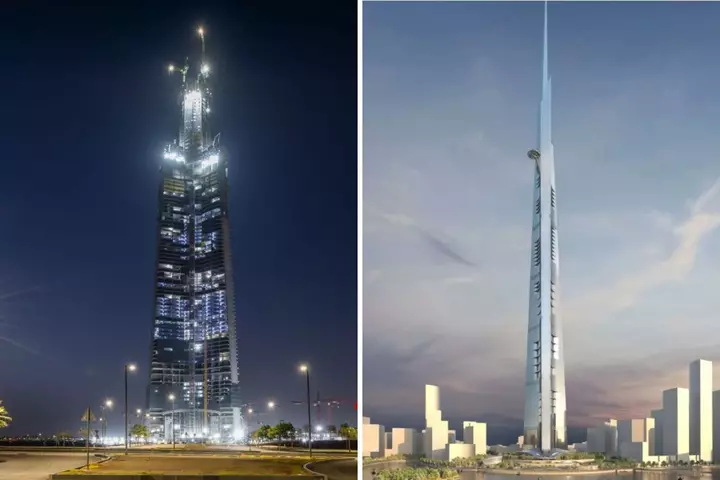
The Jeddah Tower, which will be the tallest building in the world once it is completed, is approaching a major construction milestone next month, the team behind the project told Newsweek. Designed by architects Adrian Smith and Gordon Gill, co-founders of Adrian Smith + Gordon Gill Architecture (AS+GG), and constructed by the Saudi Binladin Group (SBG), once built, the Jeddah Tower in Saudi Arabia will soar to approximately 3,281 feet high. The Jeddah Tower will dethrone the Burj Khalifa in Dubai, the current world’s tallest building, which stands 2,717 feet high.
The Burj Khalifa was also designed by Smith while he was at the SOM (Skidmore, Owings & Merrill) architectural firm, before he co-founded AS+GG. Speaking to Newsweek in London at the Vertical Urbanism (VU) Summit of the Council on Vertical Urbanism (CVU) this week, ahead of a panel discussion held there by the team behind the tower on its latest development, architect Ben Johnson, director at AS+GG, said the tower’s next major milestone will be reaching its halfway point, a height of around 1,640 feet. Johnson said the building is projected to reach this point around Thanksgiving, according to the contractor.
It will be reached “certainly within this year,” he said, noting “we're almost there.” Structural engineer John Peronto, managing principal at Thornton Tomasetti and project manager for the Jeddah Tower, also told Newsweek at the summit that the building has now hit its 121st floor and “125 will be the halfway mark.” Sharing images of the Jeddah Tower taken a few days earlier when it reached the 121st floor, Ian Norman Miller, SBG senior executive project director, who is on the construction site daily, told Newsweek: “We’ve reached 484 meters [around 1,587 feet], just another 16, four floors to go” before the halfway milestone mark. The SBG director said, “Lately we've been working at a rate of four floors a month. So, I do anticipate that milestone will be achieved [around Thanksgiving].” Asked whether it’s still on track for completion around August 2028, as mentioned in earlier months, Johnson cautiously said: “Nominally, yes, it is still on track.” Johnson also pointed out that the definition of “complete” has “kind of a wide window,” noting that structural completion and topping out differ from the building being completed and occupied.
However, he said the progress and pace of the construction have been “aggressive no matter how you measure it, but so far they are holding to that [the completion date of 2028].” Peronto clarified that the structural top out is expected to be completed by the end of 2028, noting it will be “somewhere around that Q4 [fourth quarter] time is what I understand. But I think there's been some refinement to the schedule that they're working on.” The construction of the next world’s tallest building continues amid a call for the improvement of existing buildings in the face of the growing environmental impact of new construction. Among the proponents of this is none other than Gill, the Jeddah Tower’s architect, who told Newsweek earlier this year that height is no longer the primary goal when asked about the next architectural benchmark he’d like to achieve.
According to Gill, the future of architecture lies in rethinking what we already have, not building higher structures. He previously told Newsweek: “Sustainability is what matters to me the most…to get to the point where we're contributing with buildings and turn them into assets, versus looking at them as deficits.” Around half of America’s 125 million buildings are at least 50 years old, according to the American Institute of Architects (AIA). The AIA says that repurposing existing buildings can avoid 50 to 75 percent of the carbon emissions associated with new construction, by reducing the “embodied carbon” released from the manufacturing and transporting of building materials.
Speaking to Newsweek at the VU Summit ahead of the team’s panel discussion, architect Peter Weismantle, director of supertall building technology at AS+GG, recalled being at the site of the Jeddah Tower back in June, when it surpassed Chicago’s Willis Tower. He said the contractor has “a paper on the wall about 8-feet tall that has the world's 100 tallest buildings,” which is used to note when the Jeddah Tower hits another milestone. Earlier this month, the Jeddah Tower hit another milestone, surpassing the world’s tallest all-residential tower–New York City’s Central Park Tower–which is just over 1,550 feet tall.
Extract — continue reading at the source.