Premiering in competition at Tokyo, the Chinese artist and filmmaker's second feature is less intellectually nourishing than his debut 'A New Old Play,' but is rich in culinary and cinematic pleasures. Lauded for the stylized studio environments of his debut fiction feature, 2021’s Locarno prizewinner “A New Old Play,” Qiu Jiongjiong returns to the soundstage for a second helping in his follow-up, “Fuxi: Four Tales of Feasting.” “A New Old Play” told the story of an actor who played different roles in successive epochs of Chinese history, and made his life into a three-hour pageant by using stage techniques: rippling bedsheets dyed a watery blue for ocean waves; fake plastic trees for nature. Now acting as his own production designer as well, writer-director-editor Qiu serves up more painted backdrops and practical theatrical effects, this time in an anthology film in which a cast toplined by Lee Kang-sheng play multiple roles in rhyming chapters centered around food.
It’s a four-course feast for the eyes, even if “A New Old Play’s” intertwined themes of art, memory, and China’s tumultuous 20th century offered more food for thought. The appeal to arthouse audiences is obvious, though the international critics and programmers who compared “A New Old Play” to Jia Zhangke’s politically ambitious “Platform” may find “Fuxi” less substantial. Qiu operates in a more folkloric mode, beginning with the film’s first segment, “The Ancestors’ Fuxi,” set among a prehistoric tribe whose members are recognizably human, except for their tails.
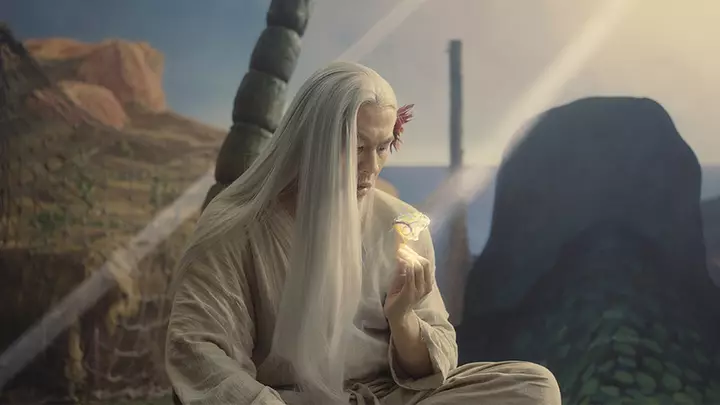
As a member of the tribe approaches the end of her life, it is explained, she cuts off her own tail, and prepares it as a soup, to feed her descendants as part of her burial rites. The dying granny, who chops away at her appendage with a prop hatchet, is played by Lee, sporting a silver wig seemingly fashioned of rope. Famous as Tsai Ming-liang’s longtime muse, Lee has a sly charisma that peeks out at the edges of even his most morose roles, as it does here.
Lee reappears as another female elder in “The King’s Fuxi,” which jumps ahead by at least one millennium — people no longer have tails, and their diet has diversified. There’s agriculture now — villagers toil behind tiered hillsides fashioned from flat boards painted with abstract green swirls — and animal husbandry. In the “Ancestors” segment, wild dogs, played by actors in masks and black unitards, howl on the village outskirts; by the second segment, they’re kept as pets, and one (voiced by Qiu himself) even narrates the story.
Society has become more hierarchical: The food Lee’s character serves is an offering to her king, who has abdicated in order to live as a bird (he floats through hand-painted clouds and smoke-machine haze on digitally removed wires), but still returns once a year to taste the tribute of his subjects. This king is based on Duyu, a figure from Sichuan legend (“Duyu” means “cuckoo”), and one who may be inspired by a real figure who introduced the core principles of farming to the region. But even as “Fuxi” moves into recorded history, it remains in a liminal space between textbook and myth, material world and spirit world.
In the third, most substantial segment, “The Litterateur’s Fuxi,” four spirits — including one played by Xue Xuchun, who portrayed a similar underworld guide in “A New Old Play” — assemble in a 1997 represented by cutouts of skyscrapers backlit through lighting-gel windows. They’re gathering to share a festive banquet at which each course triggers a memory from the life of the Song dynasty dissident poet Su Dongpo (Lee Hong-chi); amid the artifice of Qiu’s mise-en-scène, overhead shots of pork belly browning on a bubbling skillet, or fish steaming in chilis, stand out for their earthiness, and the use of offcuts such as a lamb’s spine makes a stark commentary on the pains of exile. If “Fuxi” has a political agenda, it’s to be found in this section’s look at the responsibilities of an artist, though the fourth section, “Sworn Brothers’ Fuxi,” set at the dawn of the 20th century, is much more typical in its oblique and disguised musings on the promises and disappointments of modernity.
Extract — continue reading at the source.