Brain–computer interfaces promise restored communication and movement, yet accuracy achieved under development rarely survives new sessions, users, tasks, or hardware. Generalization, not peak performance, determines clinical scalability. Here we examine generalizable neural decoding from development to deployment, organized by the domain held out at evaluation, target-data access, adaptation strategy, and the clinical conditions under which performance persists, identifying benchmarking standards, prospective validation, and hardware-algorithm co-design as prerequisites for durable benefit.
Brain-computer interfaces (BCIs) translate neural activity into commands for communication and motor control and can incorporate sensory feedback or therapeutic stimulation within closed-loop systems1,2,3,4,5,6,7,8,9. These capabilities have expanded the functional possibilities available to people with severe neurological impairments. However, a system that performs well during development may require substantial recalibration or lose performance when recording conditions, user behavior, or clinical needs change10,11,12,13.
The central deployment question is therefore whether useful function can be sustained under specified conditions and with an acceptable burden on users, caregivers, and clinical services. Answering this question requires connecting advances in neural recording and decoding to the circumstances under which their performance was evaluated. Here, generalizable neural decoding refers to preserving task-relevant performance beyond the conditions used for model development.
Cross-session, cross-participant, cross-task, cross-device, cross-site, and cross-modality generalization concern different deployment changes, and evidence along one dimension does not establish transfer along the others. Transferability concerns the reuse of learned structure, whereas adaptation describes changes made using information from the target domain. A fixed decoder evaluated on a held-out participant therefore provides different evidence from a decoder recalibrated using labeled recordings from that participant.
Clinically scalable BCIs require a broader set of conditions: sustained functional benefit in the intended population and setting, acceptable risk and cost, and manageable training, recalibration, maintenance, computational, and support requirements14,15,16. Generalizable decoding can support these conditions but does not, by itself, establish clinical scalability. Recent reviews have examined domain adaptation for neural decoding17, Edge-AI implementation15, clinical translation and outcome measures for implantable BCIs18, brain foundation models19, and generative AI in BCIs20.
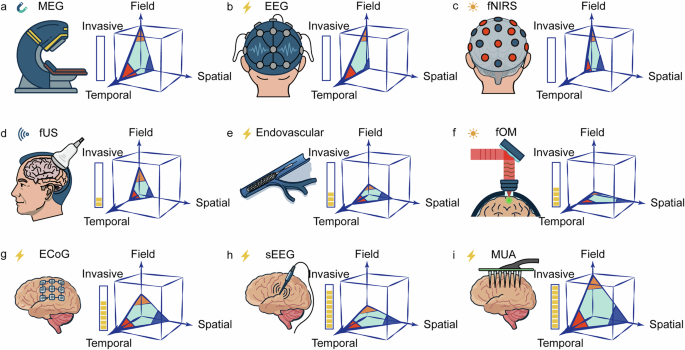
This narrative review connects these areas through a common deployment-centered framework. For each evidence stream, we examine what changes between model development and use, which domain is held out, what target-domain recordings and labels are available, how adaptation is performed, and which clinical or hardware constraints affect sustained performance. We first consider how recording interfaces shape these deployment changes, then examine decoding approaches and clinical applications, and finally address the biological, computational, and operational barriers to long-term use.
Extract — continue reading at the source.